K Cube Satellite to Support Humanity’s Deep-Space Expansion [Lunar Exploration Resumes After 54 Years]
- Input
- 2026-04-02 18:26:31
- Updated
- 2026-04-02 18:26:31
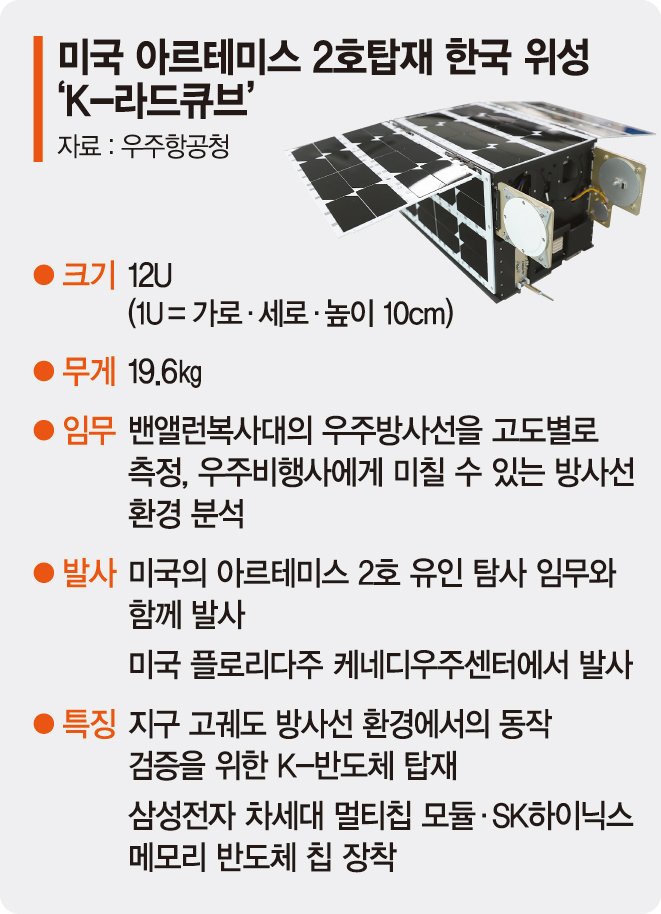
According to the Korea AeroSpace Administration (KASA) and the Korea Astronomy and Space Science Institute (KASI) on the 2nd, Korea’s cube satellite K-Rad Cube, loaded on Artemis II, was launched from the John F. Kennedy Space Center (KSC) in the State of Florida at 6:35 p.m. local time on the 1st (7:35 a.m. on the 2nd, Korea time) and was successfully deployed at an altitude of 40,000 kilometers.
K-Rad Cube, a space-radiation-observation cube satellite developed by KASI and Nara Space Technology, will carry out its mission for about two weeks. Its core task is to precisely measure the Van Allen radiation belt, a region of high-energy radiation surrounding Earth. The mission also includes an industrial objective: verifying the durability of Korean semiconductor technology in the space environment. Next-generation memory semiconductor devices developed by Samsung Electronics and SK hynix are mounted on the satellite. Industry observers expect that if Korean semiconductors prove reliable in deep-space conditions, the share of domestically made components adopted in the rapidly growing global New Space market will increase dramatically.
[email protected] Yeon Ji-an Reporter