Warning signs for Huawei’s growth engine: Consumer business slows as sanctions spread
- Input
- 2026-04-02 18:22:32
- Updated
- 2026-04-02 18:22:32
China’s Huawei posted the second-highest annual revenue in its history last year, but its revenue growth has shrunk to the low single digits.
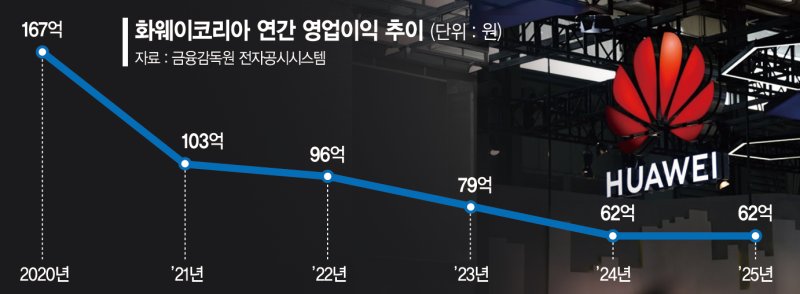
The slowdown is largely attributed to a contraction in its core cloud computing business and a sharp deceleration in revenue from its consumer segment, which includes smartphones. As the United States, the European Union (EU), Japan and other major countries maintain tough sanctions targeting Huawei, the company’s expansion plans appear to have hit a wall. Huawei Korea has also been indirectly affected by U.S. sanctions, with operating profit falling below 10 billion won in 2022 and failing to recover since then.
Cloud revenue declines
According to Huawei’s annual report released on the 2nd and foreign media reports, the company’s global revenue last year came to 880.9 billion yuan (about 194.63 trillion won). This was its second-highest figure after 2020’s 891 billion yuan, but growth clearly slowed. Huawei’s revenue increased only about 2.2% from a year earlier, just one-tenth of the 22.4% growth rate recorded in 2024.
Weak performance in the cloud computing business is cited as one of the main reasons for Huawei’s slower revenue growth. Last year, Huawei’s cloud computing revenue fell 3.5% year-on-year to 32.1 billion yuan. Growth in the consumer business segment, which covers smartphones and other digital devices, also cooled sharply. Revenue from Huawei’s consumer business reached 344.5 billion yuan last year, up a mere 1.6% from the previous year. Considering that this segment’s revenue jumped 38.3% year-on-year in 2024, the growth rate has dropped dramatically.
In its home market of China, sales of Apple’s iPhone 17 series have surged, while Huawei’s market share has declined. Market research firm Counterpoint Research reported that at the end of last year, Apple’s smartphone shipments in China rose 7.5%, whereas Huawei’s shipments increased only 1.7%. Huawei still leads, but the market share gap between the two narrowed from 1.1 percentage points in 2024 to 0.2 percentage points in 2025.
Profitability in Korean market deteriorates
Huawei is also struggling to gain traction in South Korea. According to an audit report Huawei Korea submitted to the Financial Supervisory Service (FSS) last month, the company’s operating profit at the end of last year was 6.27 billion won, down slightly from 6.284 billion won a year earlier. Over the same period, revenue rose from 208.4 billion won to 233 billion won, meaning its operating margin actually deteriorated. The company is reportedly having difficulty securing major domestic clients amid concerns over cybersecurity risks and the impact of sanctions imposed by the United States, the EU and other major countries. The United States, the EU and Japan are all moving to tighten restrictions on Huawei. Kyodo News recently reported that the Japanese government has sent guidelines to companies involved in postwar reconstruction projects in Ukraine, warning them about security risks from using Huawei equipment when building local networks.
As part of efforts to strengthen its advanced technologies, Huawei has been aggressively recruiting talent in Europe and elsewhere. Nikkei Asia reported that this has fueled calls for even tougher regulations on the company. Recently, Martin Schell, former head of the Fraunhofer Institute for Telecommunications, Heinrich Hertz Institute (HHI) in Germany, is said to have taken up a new role as head of research and development at the Huawei Bragg Research Center in the United Kingdom.
[email protected] Jang Min-kwon Reporter