Lee Un-ju: "U.S. Mentioned Investing in Nuclear Power in Korea"
- Input
- 2026-04-02 18:18:30
- Updated
- 2026-04-02 18:18:30
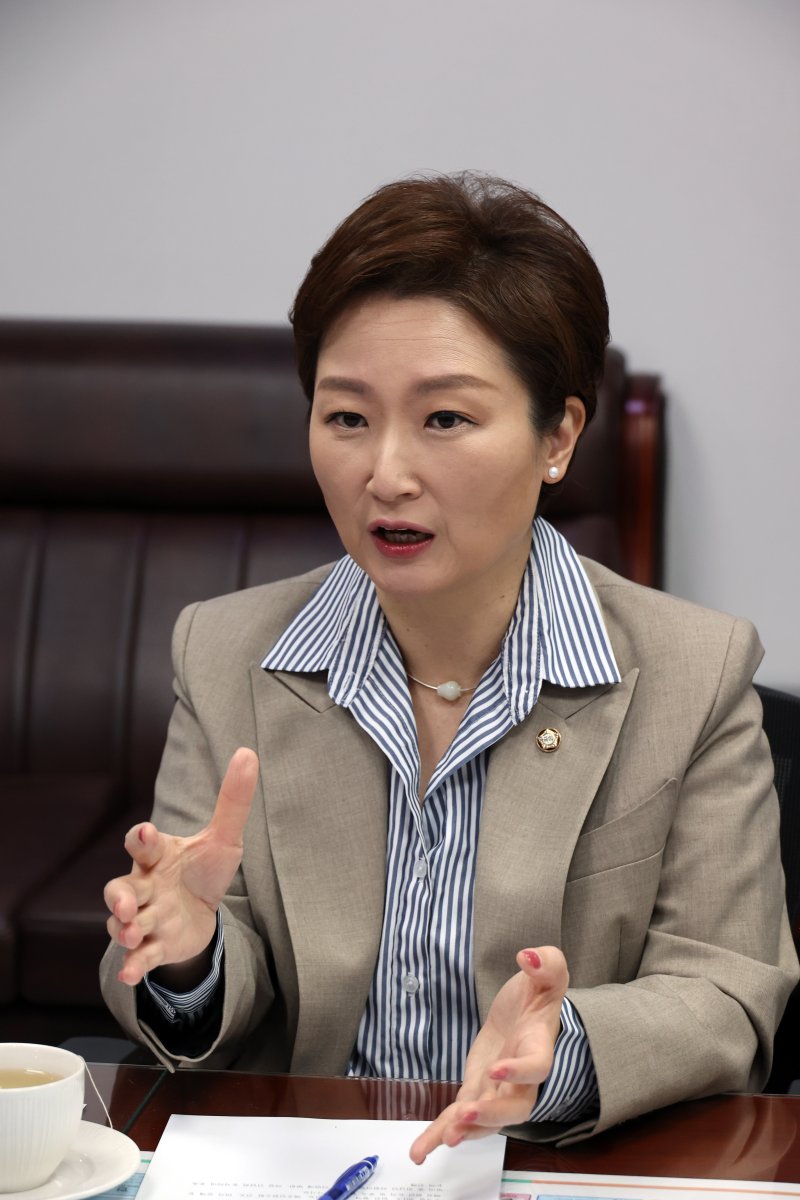
This was the account given by Lee Un-ju, a Democratic Party of Korea (DPK) lawmaker who joined the Korea-U.S. Parliamentary Association delegation to the United States, in an interview with The Financial News on the 2nd. The remarks draw attention because U.S. President Donald Trump has pledged to build 10 new large nuclear reactors by 2030.
In the interview held that day at the National Assembly Members' Office Building, Lee said, "Our country is the only one that still has a recent and valid track record in building large nuclear power plants," and added, "Japan proposed nuclear power plants as part of its investment projects in the U.S., but it has been a very long time since it directly built any." She noted that DOE is aware of this as well. Korea’s nuclear industry has built 32 reactors domestically and also constructed the Barakah Nuclear Power Plant in the United Arab Emirates (UAE). In addition, it has signed the final contract for the Dukovany Nuclear Power Plant project in the Czech Republic.
Lee said she explained this situation not only to DOE officials but also to U.S. lawmakers such as Senators Ted Cruz and Bill Hagerty, whose constituencies are seeking to host nuclear power plants. "I talked about why nuclear projects should be carried out together with Korea and about our competitiveness," she explained, adding, "Many of them have business backgrounds, so they found the arguments convincing."
However, she pointed out that the model for large reactors is a stumbling block. If the project uses the AP1000, which is based on the original technology of Westinghouse Electric Company rather than the Korean Advanced Power Reactor 1400 (APR1400) model, then under an agreement among Westinghouse Electric Company, Korea Hydro & Nuclear Power (KHNP) and Korea Electric Power Corporation (KEPCO), the parties would have to bear more than 1 trillion won per reactor in technology licensing fees and contracts for the purchase of equipment and services.
Even so, Lee argued that investment in the United States should focus on infrastructure projects such as nuclear power plants. This is because periodic Maintenance, Repair and Overhaul (MRO) can generate profits over the long term. She said, "Under the Memorandum of Understanding (MOU) on investment in the U.S., it may look like a huge loss because Korea and the U.S. split profits 5 to 5 up to the break-even point and then the ratio shifts to 9 to 1, but infrastructure projects can continue to generate profits through maintenance and repair."
Lee also pointed out that in the case of SMR (small modular reactor) projects, the vast territory of the United States can serve as a large-scale test bed. If multiple SMRs are built as part of investment projects in the U.S., the resulting data can later be used to verify SMRs for commercial deployment in Korea. "There are already several sites where the Trump administration has shortened permitting procedures through executive orders," she noted. "If we validate SMRs at those sites, we can address public acceptance issues at home," she emphasized.
Kim Yun-ho, Song Ji-won
jiwon.song@fnnews.com Reporter Kim Yun-ho Reporter