Authorities Scramble to Contain Surging Exchange Rate as $4 Billion in FX Reserves Depleted
- Input
- 2026-04-03 06:00:00
- Updated
- 2026-04-03 06:00:00
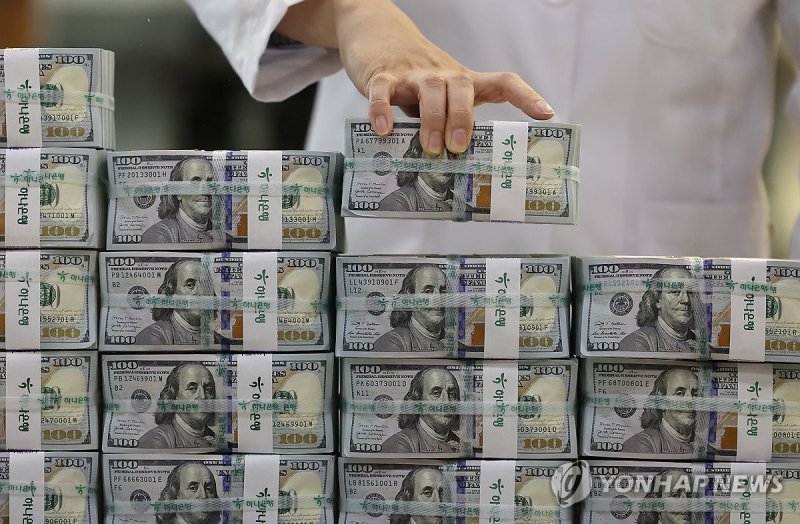
Data from the Bank of Korea (BOK) on the 3rd showed that South Korea’s foreign exchange reserves came to $423.66 billion at the end of March. This represents a decrease of $3.97 billion from the end of the previous month.
Foreign exchange reserves had fallen to about a five-year low of $404.6 billion at the end of May last year. They then increased for six straight months through November, but turned downward again in December and continued to decline in January this year, when they dropped by $2.15 billion.
In February, the Ministry of Finance and Economy issued $3 billion in Foreign Exchange Equalization Fund Bonds, pushing reserves up by $1.72 billion from the previous month. However, sustained dollar selling to stabilize the market reversed that trend again in March.
A BOK official explained, "The decline mainly reflects a lower U.S. dollar conversion value of foreign-currency assets denominated in other currencies, as well as market stabilization measures such as foreign exchange swaps with the National Pension Service (NPS)."
Within the foreign exchange reserves, securities holdings fell by $2.26 billion to $377.69 billion. Deposits and Special Drawing Rights (SDR) also decreased, by $1.44 billion and $200 million, respectively. Gold holdings remained unchanged from the previous month at $4.79 billion, while the International Monetary Fund (IMF) reserve position, a claim held by IMF member countries through quota payments and lending, declined by $60 million.
If the sharp rise in the won–dollar exchange rate does not ease, foreign exchange reserves will inevitably continue to be drawn down. The recent depreciation of the Korean won has also been driven by a surge in international oil prices, to which energy-import-dependent Korea is highly exposed, leaving room for additional foreign exchange market stabilization measures.
The exchange rate has closed in the 1,500-won range for six consecutive trading days since the 26th of last month. On the 1st, it briefly fell to 1,501.30 won on expectations of a pullback, but those hopes were dashed when Donald Trump stated, "Over the next two to three weeks, we will deliver an extremely powerful blow to Iran." The rate then finished trading at 1,519.7 won, up 18.4 won from the previous session, after touching as high as 1,524 won during intraday trading.
South Korea’s foreign exchange reserves, which can be compared in ranking with those of major countries, stood at 12th in the world as of the end of March. The country slipped from 9th in January to 10th in February, and has now fallen two more places. China ranked first with $3.4278 trillion, followed by Japan with $1.4107 trillion, Switzerland with $1.1135 trillion, the Russian Federation with $809.3 billion, India with $728.5 billion, Germany with $663.3 billion, Taiwan with $605.5 billion, Italy with $501.2 billion, France with $495.0 billion, Saudi Arabia with $476.3 billion, and Hong Kong with $439.3 billion.
[email protected] Kim Tae-il Reporter