President Lee: "A debt-free supplementary budget using excess tax revenue, without issuing government bonds"
- Input
- 2026-04-02 15:02:11
- Updated
- 2026-04-02 15:02:11
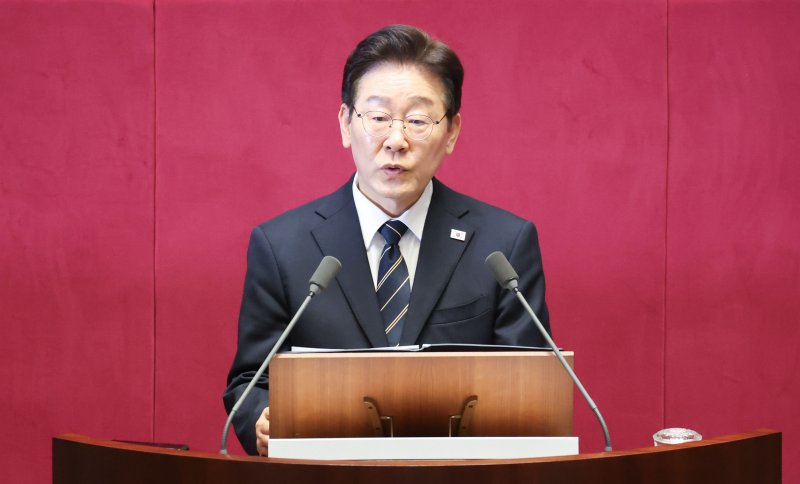
[The Financial News] President Lee Jae-myung of South Korea stressed on the 2nd that the 26.2 trillion won supplementary budget proposal, drawn up in response to the crisis in the Middle East, is "a debt-free supplementary budget that does not involve issuing government bonds." Referring to the economic shock from the war in the Middle East, he added that "the current crisis is not a brief shower that will soon pass,
but a massive storm whose duration we cannot predict," and said that a long-term response is required. President Lee went on to say, "In an emergency, we need truly extraordinary measures. Our government regards the situation as a wartime emergency for the everyday economy and people’s livelihoods, and we are making every effort to overcome the immediate crisis."
Speaking in the main chamber of the National Assembly of the Republic of Korea on the 2nd, President Lee delivered a policy speech calling for cooperation in passing the 26.2 trillion won supplementary budget bill submitted by the government. "I stand here with a sense of urgency that we must protect people’s lives and the economy in the face of the grave crisis caused by the war in the Middle East," he said.
In his address at the National Assembly, President Lee outlined the details of the so-called "war-related supplementary budget." This is the second supplementary budget proposal since the launch of the Lee Jae-myung administration in June last year.
President Lee explained, "We have designed this Middle East war crisis response so that we can invest boldly where it is truly needed, while ensuring that the burden is not shifted onto our people and the economy." He emphasized that, thanks to a gradual improvement in economic conditions, the government was able to prepare a debt-free supplementary budget that does not require issuing new government bonds. Specifically, the plan uses 25.2 trillion won in excess tax revenue, largely generated by a booming stock market and semiconductor sector, along with 1 trillion won from the funds’ own resources.
President Lee said, "We will invest more than 10 trillion won in a three-part package to ease the burden of high oil prices, in order to reduce the pain and costs people are facing." He added, "We have allocated 5 trillion won in contingency reserves to secure the resources needed for the smooth operation of the current oil price cap system and to respond to fluctuations in exchange rates and fuel costs."
He continued, "We will introduce new support payments for those hit by high oil prices, so that citizens suffering the double burden of high energy and high consumer prices can finally catch their breath." He added, "We will provide differentiated support ranging from 100,000 won to a maximum of 600,000 won per person, based on income level and regional priority, to about 36 million people in the bottom 70% income bracket."
He also said, "To serve as a reliable pillar for people struggling with difficult living conditions, we have prepared 2.8 trillion won worth of measures to stabilize livelihoods." He stressed, "It is crucial that we provide even stronger protection for vulnerable groups, who are likely to feel the impact of this crisis earlier and more severely."
[email protected] Choi Jong-geun, Reporter Reporter