Net increase in MVNO subscribers in Q1 falls by half from a year earlier as three major mobile carriers fight back with subsidies and perks
- Input
- 2026-04-05 14:26:10
- Updated
- 2026-04-05 14:26:10
[Financial News] The net increase in Mobile Virtual Network Operator (MVNO) subscribers in the first quarter of this year fell to about half the level seen a year earlier. The three major mobile carriers strengthened subsidies and number portability benefits, first by offering a penalty waiver at KT Corporation (KT) in January and then by using preorders and the launch of the Galaxy S26 series in February and March as a trigger. As a result, number portability mainly took the form of users switching between carriers, rather than leaving for MVNOs.
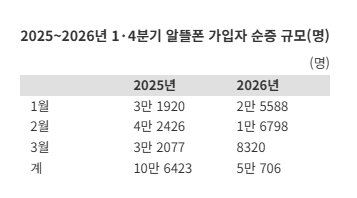
■ About 50,000 users left in Q1According to the telecommunications industry and the Korea Telecommunications Operators Association (KTOA) on the 5th, the number of subscribers who switched to MVNOs in the first quarter of this year was tallied at 50,706. This is roughly half the 106,423 who moved during the same period last year.
In January, competition over subsidies among carriers intensified due to KT’s penalty waiver. According to prices at so‐called “bargain phone” shops, during the waiver period the effective subsidy for popular models such as the Samsung Galaxy Z Flip 7 and iPhone 17 exceeded 1 million won when sales incentives (rebates) were added on top of common subsidies. For some models, subsidies even surpassed the device price, allowing customers to buy so‐called “minus phones.”
In March, the carriers also moved quickly to raise common subsidies in line with the launch of the Galaxy S26 series. When the Samsung Galaxy S25 was released in February last year, common subsidies (then called posted subsidies) were initially set at around 250,000 won and were raised to about 500,000 won only from mid‐March, roughly a month later. For the Galaxy S26 series, common subsidies were again set at 250,000 won at launch, but this time they were increased to 500,000 won in just about two weeks. Despite the fact that both last year and this year saw the disruptive effect of new Galaxy flagship launches, the pace of churn to MVNOs was clearly different. In February last year, when the Galaxy S25 series came out, 42,426 people moved to MVNOs, whereas in March this year, when the Galaxy S26 series was released, the number dropped to around 8,320.
An industry official explained, "In recent months, factors such as carrier penalty waivers have fueled competition over benefits that users can actually feel. This month, with no particular one‐off factor in play, carriers quickly raised subsidies to stimulate demand and lock in customers," adding, "This likely helped curb churn to MVNOs."
■ Impact of abolishing the Mobile Device Distribution Improvement ActThe abolition of the Mobile Device Distribution Improvement Act last July also played a role. The cap on additional subsidies, which had been limited to 15% of the common subsidy, was removed. Previously, users could receive additional subsidies only if they chose device subsidies instead of a discounted service contract. Now, they can receive additional subsidies even when they opt for the 25% contract discount. As a result, more consumers appear to be choosing to buy devices through carriers and combine subsidies with contract discounts to lower the effective price, rather than purchasing unlocked phones and using low‐cost MVNO plans.
While churn to MVNOs has slowed, the number portability market has been highly active. In the first quarter of last year, the number of people porting their numbers ranged between 490,000 and 570,000. This January, boosted by KT’s penalty waiver, the figure surged to around 990,000, then calmed to the 520,000 range in February. In March, the launch of new devices such as the Galaxy S26 series pushed the number back up to the 630,000 range. This far exceeds the 570,000 level recorded in February last year, when the Galaxy S25 series launch was reported as the highest in seven years.
An industry official said, "Even after the current wave of new device launches passes, if the carriers continue to strengthen low‐priced plans comparable to those of MVNOs, partnership benefits, and device subsidies, the scale of churn to MVNOs may not return to past levels."
[email protected] Choi Hye-rim Reporter