Kim Yong-beom: "Resilience of South Korean Stock Market Confirmed...Won–Dollar Exchange Rate Expected to Return to Stable Range"
- Input
- 2026-04-02 11:31:43
- Updated
- 2026-04-02 11:31:43
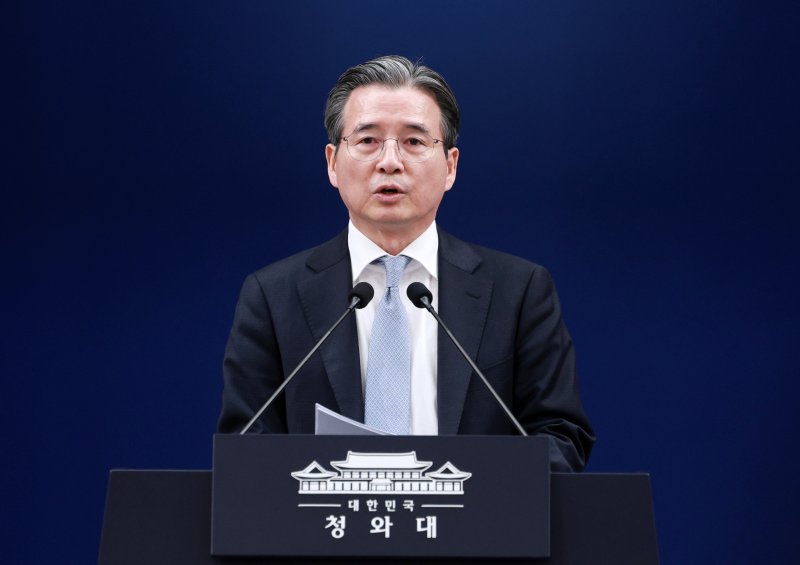
[Financial News] Kim Yong-beom, Chief Presidential Secretary for Policy, stated on the 2nd that the recent decline in the South Korean stock market and the rise in the won–dollar exchange rate, triggered by the situation in the Middle East, represented "one of the harshest scenarios the South Korean market could face, yet paradoxically became an opportunity to confirm the resilience of our market." He projected that financial markets will stabilize in the near future.
Posting on Facebook the same day, Kim said, "In conclusion, March 2026 will be remembered, when we look back later, as the period in which the South Korean stock market endured its harshest test and proved its resilience." He added this assessment while emphasizing that outcome. He went on to explain, "The won–dollar exchange rate is also expected to gradually return to a more stable range, supported by the normalization of supply and demand and institutional factors."
Kim noted, "Recently, the threat of war emanating from the Middle East hit the South Korean stock market, and there was fierce back-and-forth around the 5,000-point level of the Korea Composite Stock Price Index (KOSPI). It was a period when debate reignited in the market over whether the sharp rally that had flared up like a blaze since mid-2025 was truly grounded in fundamentals or merely a temporary bubble."
He continued, "In numerical terms, the destructive power of the recent foreign selling was nothing short of overwhelming. In February and March 2026, roughly 13.7 billion United States dollars (USD) and about 23.5 billion USD of foreign capital, respectively, flowed out of the market. For comparison, during the Global Financial Crisis (GFC) in 2008—when annual foreign selling pressure was the most intense in the history of the South Korean stock market—the figure was around 36.6 billion USD." Even so, he assessed, "The key point is that, despite this unprecedented wave of selling and the massive shock of a war in the Middle East, the South Korean stock market managed to hold the line around the 5,000 level and withstand the pressure."
Kim argued, "This shows that the South Korean stock market is not merely in a simple bull phase, but has built the structural strength needed to endure real shocks. In other words, rather than an event that exposed the market’s vulnerabilities, this adjustment was closer to a stress test that confirmed the downside under extreme conditions." He stressed, "Export competitiveness led by the semiconductor industry, expectations for corporate earnings, and the structural growth story across industries are all characteristics that are not easily undermined by short-term geopolitical events."
He also predicted that the recent rise in the won–dollar exchange rate would show signs of stabilizing. Kim said, "The exchange-rate volatility that occurred during this period also needs to be interpreted in a more multidimensional way. Before the war, the won–dollar exchange rate had been moving relatively steadily in the 1,430-won range. It then surged within a month to above the 1,500-won level, as massive USD demand for converting foreign stock-selling proceeds coincided with a stronger dollar globally." He emphasized, "On the surface, it may look like a rapid weakening of the Korean won (KRW), but if you look inside, its nature is different from that of a traditional balance-of-payments-type currency crisis."
He added, "In past phases when the Korean won’s weakness deepened structurally, a worsening current account balance, concerns over external creditworthiness, and sustained capital outflows all interacted." However, he argued, "In the current case, rather than damage to fundamentals, it is closer to a classic supply–demand shock, in which large-scale foreign selling in the stock market was rapidly converted into USD demand and pushed the exchange rate higher."
Kim further stated, "On top of this, the phased inclusion of Korea Treasury Bond in the World Government Bond Index (WGBI) starting in April 2026 is a structural factor that can, over the medium to long term, attract foreign investment into Korean bonds and contribute to stabilizing foreign-exchange supply and demand." He added, "Rather than a direct short-term factor that will immediately pull the exchange rate down, it is more likely to work in a way that reduces future volatility in the foreign-exchange market and strengthens confidence in Korean-won assets."
[email protected] Choi Jong-geun Reporter