Consumer prices rise 2.2% in March... Diesel prices surge 17% on war impact
- Input
- 2026-04-02 11:34:33
- Updated
- 2026-04-02 11:34:33
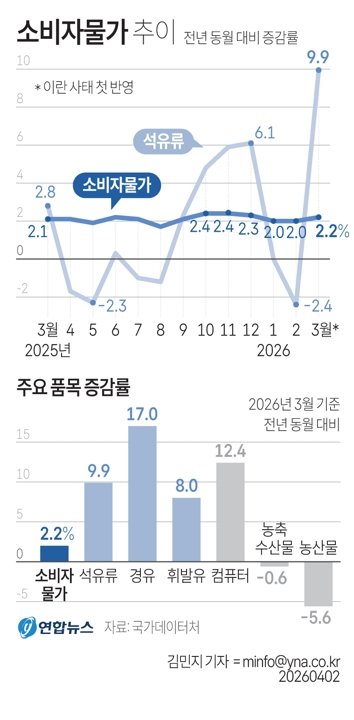
[The Financial News] Consumer prices in March were up 2.2% from a year earlier. Petroleum products jumped 9.9% due to the impact of the war in the Middle East, driving overall inflation higher. Because international oil prices rose immediately, petroleum product prices climbed in step and are expected to push up industrial goods and overall prices going forward. In contrast, agricultural, livestock and fisheries products fell on base effects from last year and increased supply. Prices of flour and sugar, which rely on imports, recorded their steepest declines in years as milling and sugar companies cut prices.
According to the Ministry of Data and Statistics’ "March Consumer Price Trends" released on the 2nd, last month’s consumer price index stood at 118.80 (2020=100), up 2.2% from a year earlier. The inflation rate has remained in the 2% range for seven consecutive months since September last year. After posting 2.4% in October and November, it eased to 2.3% in December and 2.0% in January, stayed at that level in February, and then rose by 0.2 percentage points in March. The figure is close to the government’s annual inflation forecast of 2.1%.
The concern is the geopolitical risk triggered by the United States–Iran War. Petroleum products rose 9.9%, adding 0.39 percentage points to overall inflation. The inflation rate for petroleum products was the highest in three years and five months, since October 2022 (10.3%), the year the Russo-Ukrainian War broke out. International oil prices exceeded 110 dollars per barrel due to the United States–Iran War, and this was reflected in domestic prices. However, the first phase of the maximum oil price system, introduced last month, capped retail fuel prices at gas stations and helped limit the increase.
Among petroleum products, diesel (17.0%) and gasoline (8.0%) saw particularly sharp increases. Diesel recorded its largest gain in three years and three months, since December 2022 (21.9%). Gasoline posted its biggest rise in one year and two months, since January last year (9.2%). Lee Doo-won, Director General for Economic Trend Statistics Review at the Ministry of Data and Statistics, said, "Diesel is used more widely, including in transport vehicles, so its price appears to have risen more," adding, "The designation of the second phase of the maximum oil price system, changes in international airfares due to higher jet fuel prices, and fuel tax cuts will be reflected in April’s consumer prices."
Prices related to petroleum products generally moved higher. Industrial goods rose 2.7% year-on-year, marking the largest increase in two years and five months since October 2023 (3.6%). The transportation price index also climbed 5.0% from a year earlier. Lee noted, "When petroleum prices rise, they affect imported agricultural, livestock and fisheries products through the exchange rate and transportation costs," and continued, "If the war is prolonged, it will also affect dining-out and processed foods. However, these two categories are downwardly rigid, meaning prices are hard to cut once they go up, so the impact is unlikely to show up within the next one or two months."
Agricultural, livestock and fisheries products fell 0.6% year-on-year, helping to curb overall inflation. Agricultural products dropped 5.6%, following a 1.4% decline in February. Grains (12.3%) and rice (15.6%) became more expensive, but vegetables (-13.5%) and fruit (-6.2%) were cheaper. In contrast, livestock and fisheries products rose 6.2% and 4.4%, respectively. Prices of pork (6.3%), domestic beef (6.8%), imported beef (4.3%), eggs (7.8%), yellow croaker (19.6%) and mackerel (7.2%) all climbed steeply.
Processed food prices rose only 1.6%, as the government sent strong signals urging price cuts. This was the smallest increase in one year and four months, since November 2024 (1.3%). Flour and sugar prices fell 2.3% and 3.1% year-on-year, respectively. For flour, it was the largest drop in 18 months, since September 2024 (-3.8%). Sugar recorded its steepest decline in 12 years and six months, since September 2013 (-4.4%). However, an official at the Ministry of Economy and Finance (MOEF) stated, "Even though raw material prices for processed foods are falling, petroleum products carry more weight. We judge that upward pressure on prices will be stronger going forward."
[email protected] Choi Yong-jun and Jeong Sang-geun Reporter