Economic authorities request police probe into 'forced dollar sale' fake news
- Input
- 2026-04-02 09:29:05
- Updated
- 2026-04-02 09:29:05
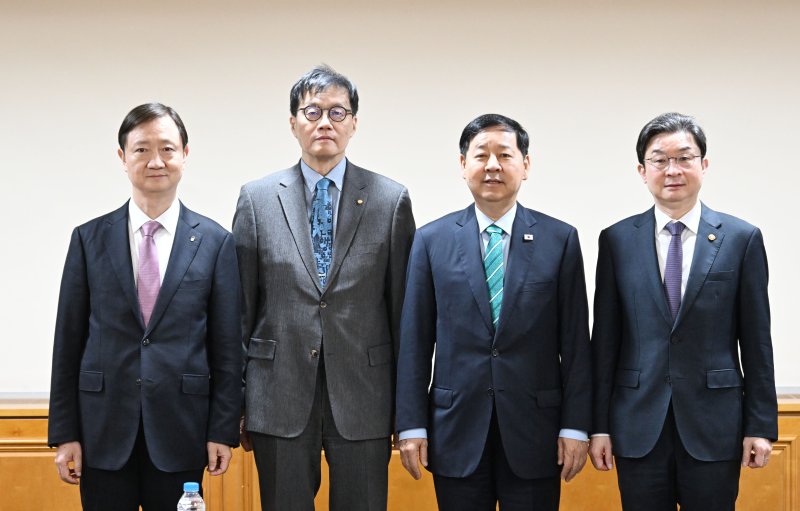
The Financial News: The economic authorities said on the 2nd that they would take stern action against the recent spread of fake news claiming that "the government will force people to sell their dollars," including requesting a police investigation.
That day, Deputy Prime Minister and Minister of Finance and Economy Koo Yun-cheol chaired a joint meeting of relevant agencies to review market conditions at the Korea Federation of Banks Building in Jung District, Seoul. He stated, "In an extraordinary crisis, the spread of baseless fake news can fuel market anxiety and undermine confidence in policy," explaining the need for a strong response.
After President of the Republic of Korea Lee Jae Myung recently mentioned the possible issuance of an Emergency Financial and Economic Order, false claims that the government would force people to sell their dollars spread rapidly on some online communities and blogs.
Bank of Korea (BOK) Governor Lee Chang-yong, Financial Services Commission Chairperson Lee Eog-weon, and Financial Supervisory Service (FSS) Governor Lee Chan-jin attended the market situation review meeting. They reviewed recent developments and risk factors in the financial and foreign exchange markets stemming from the Middle East war and discussed possible policy responses.
Participants agreed that the outcome of President of the United States Donald Trump’s press conference on the progress of the Iran–United States negotiations, scheduled for that morning, could significantly increase volatility in international oil prices as well as in the financial and foreign exchange markets.
However, they assessed that volatility in the government bond market is easing, helped by market stabilization measures such as the government’s implementation of a 5 trillion won emergency buyback.
The authorities also noted, "The Foreign Exchange Market Stabilization Tax Act passed the plenary session of the National Assembly of the Republic of Korea yesterday, and the Reshoring Investment Account (RIA) is receiving a positive response from investors." They assessed that full-fledged repatriation of overseas investment funds and increased dividends from overseas subsidiaries will help stabilize the exchange rate.
They further expected that the inclusion of Korean Treasury Bonds in the World Government Bond Index (WGBI), which officially began on the 1st, will contribute to stability in the domestic bond and foreign exchange markets. Over the past three days (March 30 to April 1), foreigners made a net purchase of 4.4 trillion won in Treasury Bonds, and authorities assessed that foreign capital, led by Japanese funds, is flowing in smoothly.
Going forward, the authorities plan to operate a joint, standing monitoring system with relevant agencies and a task force for investment promotion to closely track capital inflows.
Regarding the 26.2 trillion won supplementary budget bill submitted to the National Assembly of the Republic of Korea, they judged that its impact on inflation will be limited, given that it focuses on support for vulnerable sectors.
To maximize the effect of the supplementary budget, the authorities plan to make every effort to secure swift passage in the National Assembly of the Republic of Korea and to fully prepare for its execution. Once the budget is approved, they also intend to actively provide about 27 trillion won in policy finance through Korea Development Bank (KDB), Korea Export-Import Bank (KEXIM Bank), Industrial Bank of Korea (IBK), and Korea Credit Guarantee Fund (KODIT) to support affected companies.
[email protected] Jeong Sang-geun Reporter