President Lee, known for delivering on his pledges, moves to choke off funding for multiple-home owners to tame housing prices: "Supply is key"
- Input
- 2026-04-02 10:25:40
- Updated
- 2026-04-02 10:25:40
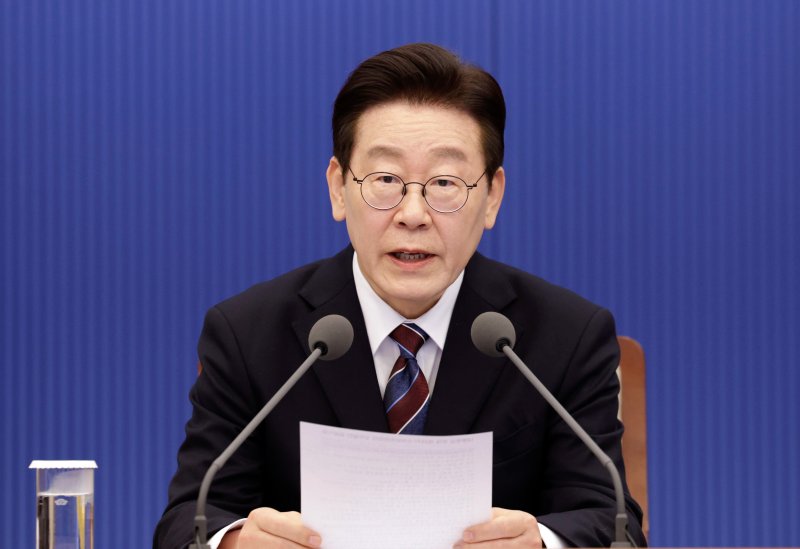
[The Financial News] The Lee Jae-myung administration has declared a policy of "insulating" finance from real estate in order to dismantle what it calls a ruinous "real estate republic." The government plans to tighten household debt management to an unprecedented level, including a principle ban on extending mortgage loan maturities for owners of multiple homes. This is the first time the financial authorities have openly used the term "insulation" as an explicit policy goal and launched such a broad-based pressure campaign.
Comprehensive pressure on multiple-home owners reflects President Lee’s resolve
The new measures are widely seen as a direct reflection of President Lee’s strong determination to normalize the real estate market.
On February 13, President Lee hinted at tough regulations in a social media post, asking, "Is it fair to grant even loan extension benefits to those who have clung to owning multiple homes, despite being given years of opportunities such as capital gains tax cuts?"
At the senior aides meeting on February 26, he stressed, "Dismantling the real estate republic is by no means an insurmountable barrier." At a Cabinet meeting in March, he added, "This time we must put an end to the practice of building up assets with other people’s money. The core of that problem lies in the financial sector."
On the 1st, the Financial Services Commission held a meeting to review household debt and decided to cap the growth rate of household lending at 1.5%, tighter than last year’s 1.7%. In a particularly drastic step, it announced a principle ban on extending mortgage maturities for owners of multiple homes in the Seoul metropolitan area and other regulated zones. In effect, the authorities intend to block the continued holding of multiple homes financed by loans.
In his opening remarks, Financial Services Commission Chair Lee Eog-weon stated, "To overcome the disgrace of being a ruinous real estate republic, we need bold insulation between the real estate market and finance." By doing so, he brought to the forefront the same sense of crisis that the president has repeatedly voiced.
Jeon Yo-seop, director general for financial policy at the Financial Services Commission (FSC), also noted at a press briefing, "Individuals have felt the urge to use loans as an investment tool to buy homes, and financial institutions have been engaging in easy business through mortgage lending." He added, "For most banks, mortgages account for more than 50% of their loan portfolios, and from now on we must prevent limited financial resources from flowing into real estate."
The FSC also fleshed out its roadmap for reducing debt. It aims to bring the household debt ratio, now at 88.6% of GDP, down to 80% over the medium to long term. To that end, it will cut the share of policy finance products such as the Didimdol Loan from 30% to 20%, and lower the guarantee ratio for jeonse loans. In particular, the Korean Federation of Community Credit Cooperatives, which sharply exceeded its lending cap last year, has been hit with a zero-tolerance penalty: its net increase in lending for this year is set at "zero."
Regulations on "gap investment" to be announced soon... Market voices say, "They must be in step with supply measures"
The regulatory squeeze is expected to tighten further. Following the new limits on loans to multiple-home owners, the authorities will soon announce additional rules targeting non-resident single-home owners. The aim is to completely shut down loan channels for so-called "gap investment"—speculative buyers who do not live in the properties themselves.
However, some in the market are voicing concern. A financial industry official commented, "The message of insulating real estate from finance is powerful, but there appears to be a lack of quantitative simulations on the policy’s impact." The official went on, "There are limits to what demand-suppression tools like loan regulations can achieve in terms of structural change in the market. In the end, it will be crucial to synchronize these measures with robust housing supply policies."
[email protected] Seong Min-seo Reporter