"War is over" – Will the Korea Composite Stock Price Index (KOSPI) break through 6,000 in one leap? "It all depends on what Trump says at 10 a.m."
- Input
- 2026-04-02 08:09:53
- Updated
- 2026-04-02 08:09:53
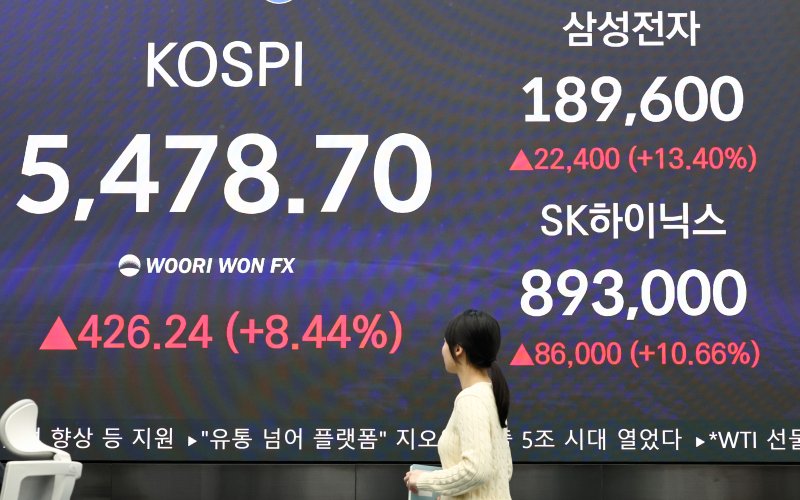
According to The Financial News, expectations that the war involving the Islamic Republic of Iran may be coming to an end have sharply improved previously depressed investor sentiment and revived appetite for risk assets, driving the KOSPI to its largest one-day gain in about a month.
With a speech by United States of America (US) President Donald Trump scheduled for later in the day, some analysts say that if he makes further comments about ending the war, the index could quickly attempt to reclaim its previous peak. They add that regaining the so-called "six-thousand KOSPI" level is well within reach.
KOSPI jumps 426.24 points in a single day on the 1st... second-largest gain on record
According to the Korea Exchange on the 2nd, the previous day the KOSPI closed at 5,478.70, up 426.24 points (8.44%). This was the second-largest daily point gain on record, following the 490.36-point jump (9.63%) on the 5th of last month. As military tensions surrounding the Islamic Republic of Iran appeared to enter a phase of easing, investors’ preference for risk assets rebounded rapidly.
The key question now is whether the index can reclaim the "six-thousand KOSPI" level. Just before the war broke out, on February 27, the KOSPI hit an intraday all-time high of 6,347.41, and on a closing basis it set a record at 6,307.27 on February 26. With the index now back above the 5,470 level, calculations show it needs to rise roughly 500 points, or about 9.5% from the current level, to reach 6,000.
Brokerages say that if war-related risks clearly move into a resolution phase, the KOSPI is highly likely to attempt a short-term breakout above the 6,000 level again. Given that the index rebounded more than 8% in just one day, they also note that the timing of a retest of the previous peak could come earlier than expected, depending on how quickly investor sentiment recovers.
However, because markets have already priced in expectations of an end to the war in the absence of a definitive confirmation, there is concern that index volatility could increase depending on how related events unfold. Some analysts also caution that the upward path is unlikely to be a straight line, and that heightened volatility is likely as the market digests each new development.
In the end, the decisive factor is the US... What will come out of Trump’s mouth?
Going forward, the main variable will be the US administration’s external messaging. President Donald Trump is scheduled to deliver a speech on issues related to the Islamic Republic of Iran at 10 a.m. Korea time. Markets are on high alert to see whether he will offer more concrete comments on the timing of an end to the war.
Previously, on March 31 (local time), President Trump suggested a possible end point to the conflict, stating at a White House executive order signing ceremony that military operations inside the Islamic Republic of Iran could be concluded within two to three weeks. Commenting on this, Lee Kyung-min of Daishin Securities said, "Expectations for an end to the war with Iran are spreading," and added, "With dovish remarks from the leaders of both the US and Iran, the market is pricing in the possibility of a cease-fire in advance, and as a result, risk appetite is expanding."
Lee Jae-won, research analyst at Yuanta Securities Korea, also noted, "The index’s rise was driven by growing expectations that both of the two main factors behind the market’s decline—concerns over the semiconductor industry and geopolitical conflict—are easing," and assessed, "The KOSPI 12-month forward price-to-earnings ratio is 7.6 times, a deep-value zone that has already priced in a recession on the scale of the financial crisis."
[email protected] Kim Hee-sun Reporter