Will Trump Declare an End to the War in His National Address, and What Lies Ahead for the Korean Stock Market?
- Input
- 2026-04-02 06:00:00
- Updated
- 2026-04-02 06:00:00
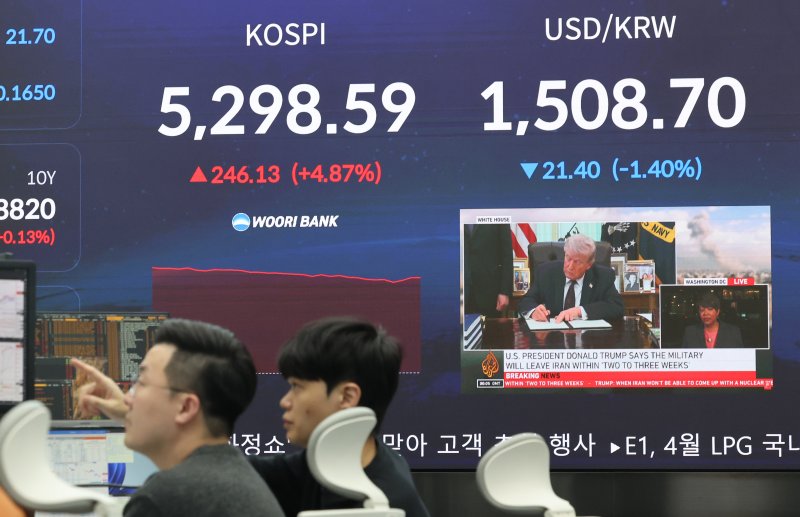
According to Financial News, there is growing speculation that President Donald Trump of the United States will declare an end to the war, or at least present a concrete roadmap for ending it, in his upcoming national address. As the domestic stock market, which had been on a strong upward run, was shaken by the war, investors are now focused on where the market will head next.
According to the Korea Exchange (KRX) on the 2nd, the previous day the KOSPI and KOSDAQ closed up 8.44% and 6.06%, respectively. The KOSPI’s point gain of 426.24 was the second-largest in history. The record was set on the 5th of last month, when the index jumped 490.36 points, its biggest-ever daily rise, as bargain hunters moved in after the index plunged on the outbreak of war involving the United States, Israel and Iran.
Investor sentiment improved on expectations that the war between the United States and Iran will soon come to an end. President Donald Trump said that cease-fire talks with Iran were going well, while Masoud Pezeshkian, president of Iran, also stated that his country was ready to end the war if there were no further attacks.
President Donald Trump is scheduled to deliver a national address on the Iran war at 10 a.m. on the 2nd (9 p.m. on the 1st local time). At an executive order signing ceremony at the White House the previous day, he suggested a timeline for ending the conflict, saying that US military operations against Iran could be wrapped up within two to three weeks.
Brokerage analysts largely expect President Donald Trump to refer to an end to the war in this address, and they forecast that the Korean stock market will gradually stabilize as a result.
Ha In-hwan, a researcher at KB Securities, noted, "With an election approaching, the Trump administration has no choice but to put greater weight on policies to control inflation," adding, "Given that oil prices have surged because of the war with Iran, it will be difficult for the Trump administration to allow the conflict to drag on for a long time."
He went on, "Although last month’s macro environment was the worst possible for the Korean economy, with rising oil prices, a weaker currency and higher interest rates, forecasts for operating profits in the first quarter and for the full year have been revised upward," and added, "With earnings season set to begin this month, expectations for corporate results are likely to underpin a rebound in the market, especially as the KOSPI price-earnings ratio (P/E ratio) is at a historically low level."
However, as geopolitical risks have persisted longer than initially expected, many observers believe it will take time for the market to return to pre-war levels.
Lee Young-won, a researcher at Heungkuk Securities, explained, "The war has already gone beyond the initially announced four-week timeframe, so even if negotiations on ending the conflict gain momentum, a significant impact on the real economy is unavoidable," and predicted, "Higher energy prices will have a direct effect on inflation."
He added, "Even if an early end to the war becomes more concrete, the overall economic shock will depend on how stably supply chains are managed," and continued, "A clearer outlook on when the war will end needs to come first, but expectations for a subsequent recovery will ultimately be determined by the extent of damage to the real economy and how far valuations can bounce back."
[email protected] Seo Min-ji Reporter