Retail investors chasing short-term trades: Owners changed for four out of every ten shares
- Input
- 2026-04-01 18:32:21
- Updated
- 2026-04-01 18:32:21
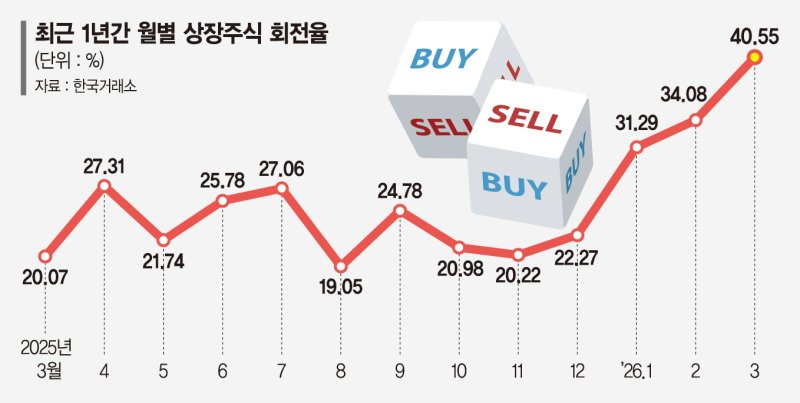
According to the Korea Exchange (KRX) on the 1st, the turnover of listed stocks in March this year was 40.55%. This marks a steep rise from January (31.29%) and February (34.08%). In just two months, the ratio jumped by nearly 10 percentage points, indicating a rapid increase in trading frequency.
Turnover last exceeded 40% in April 2023, when it reached 42.31%, meaning it has taken 2 years and 11 months to return to that level. However, it is still only about half of the 83% recorded in April 2021, at the height of the Coronavirus disease 2019 (COVID-19) retail trading boom. Despite a decline in investor deposits last month, which slowed the inflow of new money, trading value remained high, leading to the assessment that short-term trades using existing funds have increased.
In fact, the average daily trading value last month was 43.8547 trillion won, far above last year’s monthly peak of 27 trillion won in average daily trading value. As investor deposits shrank, this is interpreted as evidence that rotational trading using existing funds continued.
Last month, individual investors were net buyers of 32.8419 trillion won, while foreign investors were net sellers of 35.7122 trillion won, highlighting a clear divergence between major investor groups. Experts explain that individuals repeatedly bought during downturns and sold into rallies, thereby driving the expansion in trading activity.
Ko Yeon-su, a researcher at Hana Securities, said, "In January and February, a focus on exchange-traded funds (ETFs) tended to dampen turnover. However, in March, net buying of ETFs by individuals decreased, while buying interest in individual stocks began in earnest," adding, "This shift translated into higher turnover."
Brokerage analysts believe these volatile market conditions are likely to persist for the time being. As uncertainty over the path of oil prices and interest rates stemming from Middle East risks has yet to be resolved, some predict that the market could continue to swing sharply whenever the geopolitical situation changes.
Kim Yong-gu, a researcher at Yuanta Securities Korea, noted, "The war in the Middle East has evolved into a complex conflict involving the United States of America (U.S.), the State of Israel, and Iran, creating a phase where past experience offers little guidance," and went on, "With earlier optimism and rebound expectations having lost momentum, the stock market is likely to move up and down without clear direction as the course of the war changes."
Experts agree that investors need to be cautious, as short-term trading tends to increase in highly volatile markets. An official in the brokerage industry commented, "In a market where large price swings occur repeatedly within a single day, short-term trading naturally increases," but warned, "If investors become too accustomed to a pattern of buying on declines and selling on rallies, their losses could be substantial if the market suddenly moves in an unexpected direction."
The domestic stock market also showed significant volatility on this day. The Korea Composite Stock Price Index (KOSPI) closed at 5,478.70, up 426.24 points (8.44%) from the previous session. During intraday trading, a buy-side sidecar, a mechanism that temporarily suspends program sell orders, was also triggered.
[email protected] Bae Han-geul Reporter