Park Soo-min: "Jobs and housing are Seoul’s most urgent issues... 60,000–70,000 homes to be supplied annually" [June 3 local election contender]
- Input
- 2026-04-01 18:30:50
- Updated
- 2026-04-01 18:30:50
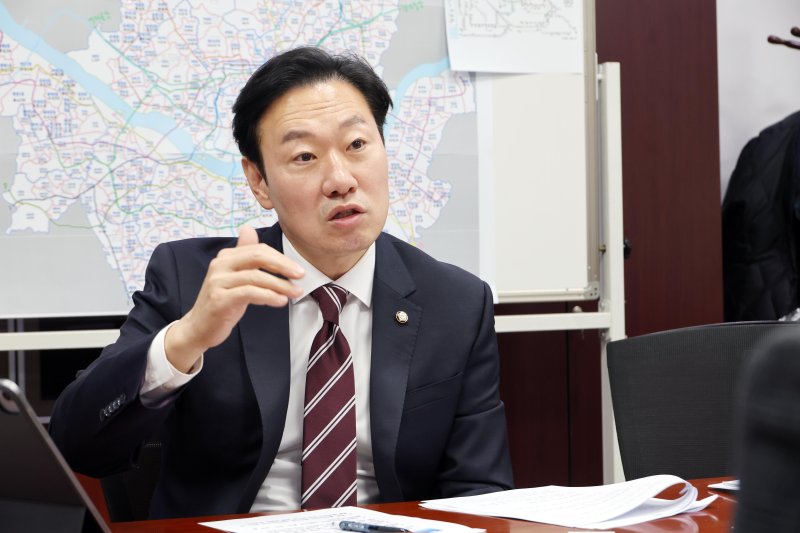
Park Soo-min, a lawmaker running in the PPP primary for Seoul mayor, declared that if elected, he will fight for Seoul residents by clinging to the coattails of the President of the Republic of Korea and other key government officials if necessary. He stressed in particular that if a hike in the real estate holding tax, which has recently been floated within the ruling camp as a possible element of the July tax reform package, is pushed forward, he will move to block it. The Seoul mayor is the only local government head in the country who can attend meetings of the State Council and is often described as a "little president" because of the office’s clout.
In an interview with The Financial News at his office in the National Assembly Members' Office Building on the 31st of last month, Park identified jobs and housing as the most pressing issues facing Seoul. He believes that once stable housing supply is secured, problems related to childbirth, childcare, and education will naturally ease as secondary issues. "When jobs and the housing ladder are stable, people can get married, have children, and build their lives," he said. "But how many people are fully prepared from the start? People are not marrying or having children because their jobs and housing are insecure."
Park is also a father of five. "What I have felt while raising five children is that what you need to raise kids is time and money," he noted. "We must provide mechanisms that guarantee time, such as parental leave and sharing of household chores. If families lack the financial resources, local governments need to step in and help. Saying you will raise the birth rate without guaranteeing this is nothing short of a thief’s mindset," he criticized.
In Park’s view, the fundamental issues that rob Seoul residents of their "time and money" ultimately come down to urban design and housing. As home prices keep rising, people resort to panic buying and drain their finances. At the same time, jobs are concentrated around Gwanghwamun, Gangnam District, and Yeouido, making commuting difficult and time-consuming. Park said he intends to completely redesign this structure and, in doing so, untangle the many intertwined problems the city faces.
His first plan is to secure Seoul residents’ "money" by stabilizing housing supply and eliminating panic buying. "If we supply housing steadily every year, people can buy a home at the right time in their life cycle," he explained. "Because supply is unstable, panic buying occurs and prices swing wildly." He aims to stabilize real estate sentiment by ensuring that 60,000 to 70,000 homes are supplied each year through private-sector initiatives. He then plans to restore the housing ladder for young people and newlyweds by revitalizing villa, a low-rise multi-family housing type in South Korea, Officetel units, and the rental market for monthly and jeonse leases. For those whose income is too low to cover monthly rent, he said the city would support housing costs through a voucher program.
To guarantee Seoul residents’ "time," Park is proposing what he calls the "Eight Sub-Centers Era." He analyzes that Seoul currently operates under Seoul’s three-core urban structure (centered on Gwanghwamun, Gangnam and Yeouido), where businesses are clustered in those three areas. With the population projected to grow by the equivalent of roughly ten mid-sized cities while this three-core structure remains intact, he argues that the root of the problem cannot be resolved. "When everyone in Seoul has to commute to just three core districts, chaos is inevitable," he said. By redesigning areas such as Eunpyeong District and Nodogang (a portmanteau of Nowon-gu, Dobong-gu, and Gangbuk-gu in Seoul) as additional urban centers, he expects the gap between northern and southern Seoul to narrow naturally. "We should have started this when our per capita Gross National Income (GNI) reached 20,000 dollars," he pointed out. "We need to usher in the Eight Sub-Centers Era as soon as possible." Follow-up measures, he added, would include a full redesign of the city’s transportation network.
Park predicted that Seoul’s growth will not necessarily worsen regional imbalances caused by overconcentration in the capital. Once the Eight Sub-Centers Era begins, he believes Seoul can grow into a global city on par with New York City (NYC) or London. If the city provides space for foreign venture companies to establish a presence in Seoul, he argued, jobs will increase while the number of people leaving the city will not. "Seoul will remain attractive no matter what," he said. "We can rent out homes in Seoul to foreigners, while retired citizens live comfortably in the suburbs on rental income."
However, Park’s vision of expanding housing supply led by the private sector could clash with the central government’s real estate policy, which focuses on curbing demand. "We need to redesign the capital gains tax. This is not the time to raise the property holding tax," he argued. "If I become Seoul mayor, I will meet with the President of the Republic of Korea, the Prime Minister of South Korea, and the Deputy Prime Minister for Economic Affairs and make the case that raising the property holding tax is not the answer. I will also stress that relying solely on public rental housing will inevitably leave us short on supply."
With the Democratic Party of Korea (DPK) currently leading in the race, Park was asked how he differentiates himself from rival candidates Jung Won-oh, Park Joo-min, and Jeon Hyun-hee. He replied that he is "the candidate who can put Myeongsim (a nickname referring to President Lee Jae-myung’s intentions) most at ease." While other candidates, he claimed, are relying on Myeongsim, he is promising to "solve Seoul’s problems on my own" and thereby lighten the President’s burden. "Given the Iran War, negotiations with the United States, and other issues, imagine how difficult things already are for the President," he said. "We should let him focus on those matters and leave it to the Seoul mayor to get housing prices under control."
haeram@fnnews.com Lee Ha-ram