"Multi-homeowners who have been holding out will flood the market with listings when leases end"
- Input
- 2026-04-01 18:27:25
- Updated
- 2026-04-01 18:27:25
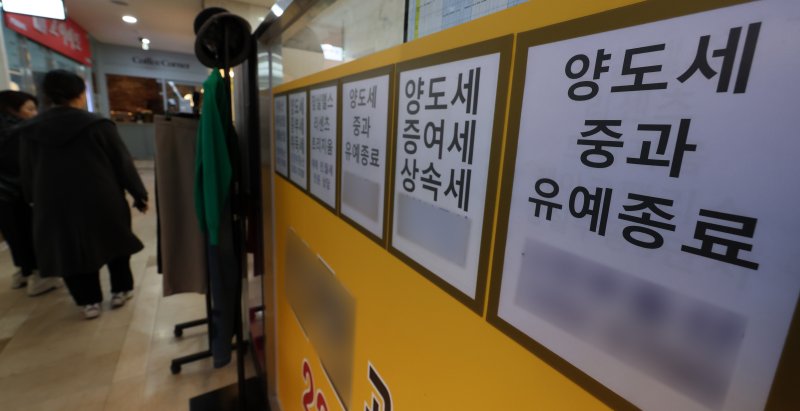
On the 1st, the real estate industry predicted that, under the 2026 Household Debt Management Plan announced by the government that day, more properties are likely to be listed, especially by borrowers with low cash liquidity. Kim Hyosun, chief expert at the WM Star Advisory Group of KB Kookmin Bank, said, "In a high interest rate environment, there is a strong possibility that more properties will hit the market from owners who cannot handle principal repayments," adding, "In particular, we are likely to see a surge of urgent sales timed to the expiration of lease contracts." If a lease contract ends in two years, the policy allows mortgage maturity to be extended for those two years, effectively giving owners a window beyond May 9 to dispose of additional homes depending on their lease situations.
Analysts also see room for continued price declines, especially in high-priced areas. Nam Hyuk-woo, a real estate researcher at Woori Bank, noted, "As the net of lending regulations becomes much tighter than in the past, the burden of raising funds will increase," and added, "With backdoor borrowing now blocked, we expect a continued period of price adjustment, particularly in the ultra-luxury segment and in areas centered on Gangnam, Seoul and the Seocho District."
Experts, meanwhile, agreed that the latest measures go beyond simply capping the total volume of household loans and represent an attempt to make the real estate leverage structure more sound over the medium to long term. With the government explicitly aiming to "decouple the real estate market from finance," they expect that changing the structure of lending itself will have lasting effects on the property market.
Kim Hyosun said, "It is time to discard the notion that leverage is always advantageous when investing in real estate," and continued, "The government has pledged to lower the debt-to-Gross Domestic Product (GDP) ratio to 80 percent, which suggests that borrowing conditions will remain tight for the next several years."
However, some warn of side effects such as a reverse jeonse crisis in multi-owned properties and a sharp drop in jeonse listings. Yang Ji-young, an expert at Shinhan Premier Pathfinder, said, "Landlords facing heavier repayment burdens may try to adjust jeonse prices," and cautioned, "If limits on maturity extensions and tighter loan caps overlap, the risk of 'reverse jeonse–driven financial accidents' could grow, particularly among landlords with weak financial capacity." She stressed that only with close monitoring and supplementary measures to address secondary risks arising from policy blind spots can the measures be truly effective.
Ham Young-jin, head of the Real Estate Research Lab at the WM Sales Strategy Department of Woori Bank, added, "This could reduce the supply of apartment jeonse units and accelerate a shift to monthly rents, which may weigh on the apartment rental market even if it helps stabilize the sales market."
[email protected] Jeon Min-kyung Reporter