Dunamu and Bithumb Post Weak Earnings, Focus on Regulation and Revenue Diversification [Crypto Briefing]
- Input
- 2026-04-01 15:41:44
- Updated
- 2026-04-01 15:41:44
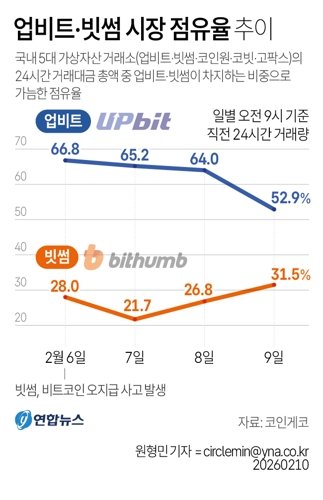
According to Financial News, Dunamu and Bithumb, the two leading domestic virtual asset exchanges, disclosed their business performance and strategies in last year’s business reports. Despite a decline in revenue, Dunamu is focusing on expanding its ecosystem through strategic equity investments in areas such as entertainment. Bithumb increased its trading fee income by more than 28% year-on-year, but its net profit fell by more than half due to accounting factors related to changes in its governance structure. For both companies, managing regulatory risks, integrating into the formal financial system, and diversifying revenue sources remain common challenges.
According to the Data Analysis, Retrieval and Transfer System (DART) of the Financial Supervisory Service (FSS) on the 1st, Dunamu’s consolidated operating revenue came to 1.5578 trillion won last year, down 10.0% from a year earlier. Over the same period, operating profit fell 26.7% to 869.3 billion won. Net profit declined 27.9% to 708.9 billion won. The company attributed this to lower trading volumes in the virtual asset market amid a global economic slowdown.
In response, Dunamu has continued equity investments to strengthen its business competitiveness and secure new growth opportunities. The most notable case is its investment in entertainment company Hybe. Dunamu holds a 5.42% stake in Hybe, with the equity-method book value estimated at about 565.7 billion won at the end of last year. Market observers view this as a strategic investment aimed at creating synergies with Web3 (Web 3.0)-based entertainment businesses. Dunamu has also acquired a 74.99% controlling stake in creator commerce platform Rebels, bringing it in as a subsidiary. Rebels, in turn, controls creator management subsidiary Archive Entertainment, in which it holds a 60% stake.
On the financial side, regulatory risks from the financial authorities have started to show up in the numbers. Dunamu recognized the 35.2 billion won fine imposed last year by the Financial Intelligence Unit (FIU) as a provision and reflected it in its financial statements. Although the three-month partial business suspension ordered by the FIU has been put on hold after Dunamu filed a lawsuit and an injunction request with the Seoul Administrative Court, the final outcome of the legal dispute could still affect the company’s future operating performance.
Bithumb is trying to close the gap with Upbit by strengthening its exchange competitiveness through a flexible fee policy and other measures. Its trading fee income increased by more than 28% year-on-year last year, leading to improved earnings. Bithumb’s revenue and operating profit reached 651.3 billion won and 163.5 billion won, respectively, up 31.2% and 22.3% from the previous year.
Last year, Bithumb carried out a spin-off, transferring its holding and investment business to a new entity, Bithumb Investment. Through its holding company Bithumb Holdings, Bithumb also maintains a 33.17% stake in CodeVASP, a travel rule solution provider, as part of efforts to enhance its Anti-Money Laundering (AML) framework.
However, net profit fell by more than 50% compared with the previous year. The company explained that this was not due to a deterioration in core performance, but rather because valuation losses from the decline in virtual asset prices were booked as non-operating expenses, which in turn reduced net profit.
Market experts widely argue that virtual asset exchanges need to move away from a fee-centric revenue model. A virtual asset industry official said, "As the market matures, it becomes increasingly important for exchanges to function not just as intermediaries, but as platforms that support investment," adding, "The ability to provide asset management services that retain users even in a bear market will be the key battleground going forward."
[email protected] Kim Mi-hee Reporter