Full Farmland Survey to Start in Gyeonggi Province First...Conflicts Over Idle and Inherited Farmland Likely to Grow
- Input
- 2026-04-01 11:16:16
- Updated
- 2026-04-01 11:16:16
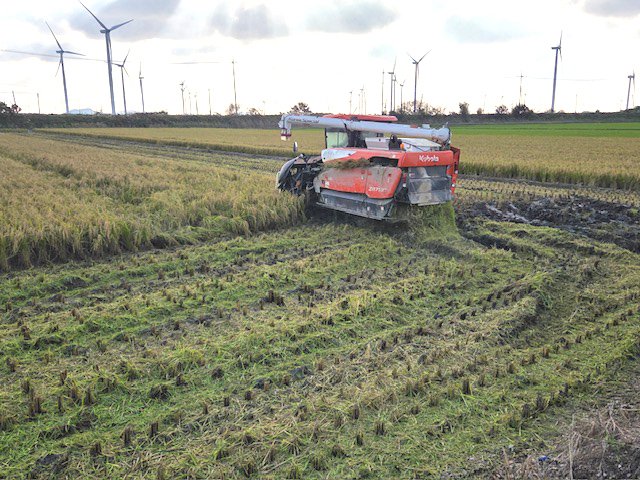
The government will launch a full-scale survey this year on farmland located in the Seoul metropolitan area and within land transaction permit zones, The Financial News has learned. It will deploy 5,000 surveyors to closely examine whether the land is actually being cultivated, a core element of the constitutional land-to-the-tillers principle, which holds that only those who farm may own farmland. The government is also pushing to revise the Farmland Act so that it can immediately issue disposal orders when unauthorized idle land or illegal leases are uncovered. Next year, the survey will be expanded nationwide to build a comprehensive farmland database.
However, resistance on the ground is expected. As rural areas age, inherited farmland is increasing rapidly, and more city residents now own farmland, making it difficult to clearly determine who is actually farming the land. There are also concerns that the survey results could lead to tougher regulations.
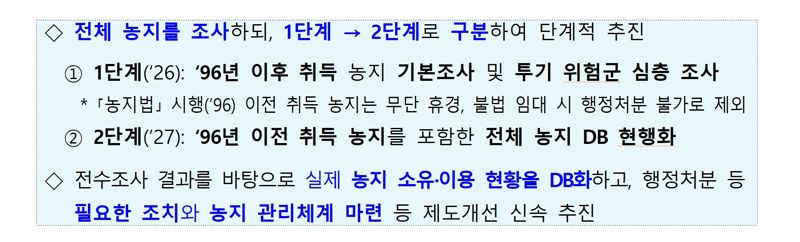
The Ministry of Agriculture, Food and Rural Affairs (MAFRA) discussed this full farmland survey plan at a ruling party–government consultative meeting on the 1st. According to the Farmland Ledger, total farmland amounts to about 1,954,000 hectares (14.47 million parcels). In the first phase, the government plans to survey 1.15 million hectares of farmland acquired since 1996 this year, and in the second phase, to examine 800,000 hectares acquired before 1996 next year. The phases were divided in light of the fact that land held at the time the Farmland Act took effect in 1996 is not subject to mandatory disposal requirements.
The first-phase survey will begin between May and July with a basic review using administrative data and satellite imagery to select targets for in-depth inspection. From August to December, on-site inspections will be carried out, focusing on 10 high-risk categories for speculation.
Surveyors will check whether the land is actually being farmed, as well as any unauthorized fallowing or illegal conversion of use. The survey items include ownership status, whether the land is under actual cultivation, whether any facilities have been installed or the land has been converted, and whether the land is lying idle. Actual cultivation will be verified jointly by township and town farmland committees and farmers’ organizations.
The high-risk group for speculation covers a total of 720,000 hectares. It includes land transaction permit zones and the entire Seoul metropolitan area (220,000 hectares, 1.73 million parcels), buyers who acquired land through auctions, farmland owned by agricultural corporations or foreigners, farmland that received a farmland acquisition certificate in the past 10 years (excluding inheritance), owners who live outside the jurisdiction, co-owners, land previously flagged in earlier surveys, and parcels suspected of illegal use.
The main focus of the survey will be Gyeonggi Province. Last year, the actual transaction price of farmland in Gyeonggi Province averaged 607,000 won per 3.3 square meters, 7.4 times higher than South Jeolla Province’s 82,000 won. By contrast, the national average was 177,000 won and has been declining since 2021.
The government will set up a Government Joint Task Force for Farmland Survey and System Improvement and plans to hire about 5,000 survey personnel through the National Agricultural Products Quality Management Service and other bodies. Depending on the type of violation found, farmland will be subject to administrative sanctions or guidance. In particular, the system will be revised so that violations within land transaction permit zones can be met with immediate disposal orders without any grace period. The survey results are to be reflected in the Farmland Ledger by December this year.
On the ground, there are already signs of potential backlash. Many inherited plots owned by elderly farmers or city residents are left unattended, and such cases are not uncommon.
Yoon Won-seub, Director General for Agricultural Policy, explained, "The law specifies certain reasons that justify leaving land idle, such as overseas travel, pregnancy, or natural disasters," adding, "If it is difficult to farm the land directly, owners can make use of legal lease arrangements."
He went on to say, "Inherited farmland of up to 1 hectare can be owned even without self-cultivation," and added, "If the area exceeds that, part of it must be leased out or entrusted, and the remainder must be consigned to the Korea Rural Community Corporation in order for ownership to be recognized." He also stated, "For cases involving sham self-cultivation and other circumventions, we plan to provide a prior guidance period and then induce owners to convert these into formal lease contracts."
MAFRA maintains that whether this survey will lead to stronger regulations will be decided after reviewing the results. Yoon stressed, "The goal is not so much to tighten regulations as to restore proper order in the use of farmland," and emphasized, "Sound farmland policy is only possible when accurate information is in place."
Experts, on the other hand, argue that the purpose of the survey is somewhat unclear. They contend that the focus should be placed more on building data to support agricultural policy than on detecting speculative activity.
[email protected] Choi Yong-jun Reporter