U.S. Sends Third Aircraft Carrier to the Middle East, Steps Up Pressure on Iran Before War’s End
- Input
- 2026-04-01 11:25:36
- Updated
- 2026-04-01 11:25:36
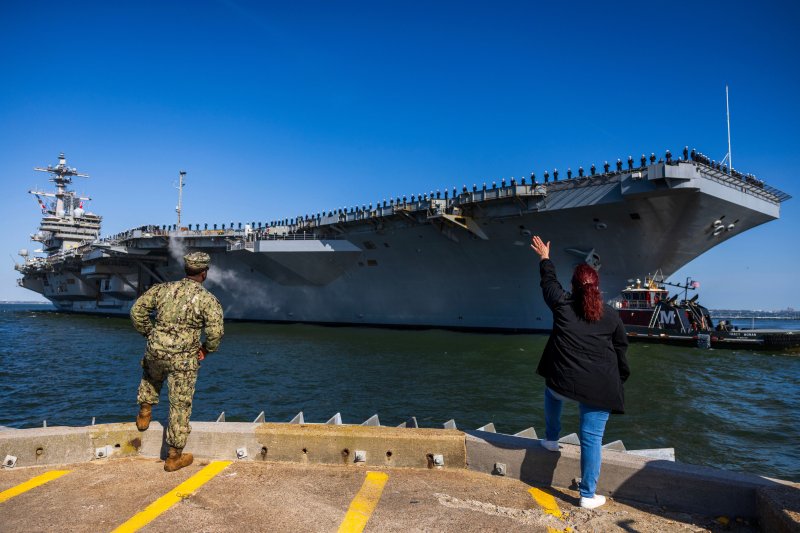
According to Financial News, as it has become known that the United States of America (U.S.) plans to wrap up its war with the Islamic Republic of Iran within “two to three weeks,” a third U.S. aircraft carrier has set sail toward the Islamic Republic of Iran. This move is seen as an attempt to intensify attacks before the end of the war and pressure the Islamic Republic of Iran into accepting a cease-fire agreement.
Local media including The Wall Street Journal (WSJ) reported that the U.S. Navy’s aircraft carrier USS George H.W. Bush (CVN-77) and its escort ships departed Naval Station Norfolk in Virginia on the 31st of last month (local time) bound for the Middle East. Officials said the George H.W. Bush will join two U.S. aircraft carriers already deployed in the Middle East, temporarily increasing the number of U.S. carriers in the region to three.
However, the number of carriers actually taking part in strikes on the Islamic Republic of Iran is expected to remain at two, as before. Earlier, U.S. President Donald Trump signaled possible military intervention in connection with anti-government protests in the Islamic Republic of Iran and redeployed the U.S. Navy aircraft carrier USS Abraham Lincoln (CVN-72) from the Indo-Pacific to the Middle East. In February, the USS Gerald R. Ford (CVN-78) was also sent to the Middle East. Commissioned in 2017, the Ford is still regarded as the world’s largest aircraft carrier; it left Norfolk in June last year and arrived near the Mediterranean Sea. As U.S. pressure on Venezuela increased, the Ford moved to the Caribbean Sea, then returned to the Mediterranean Sea and headed for the Red Sea to take part in operations against the Islamic Republic of Iran.
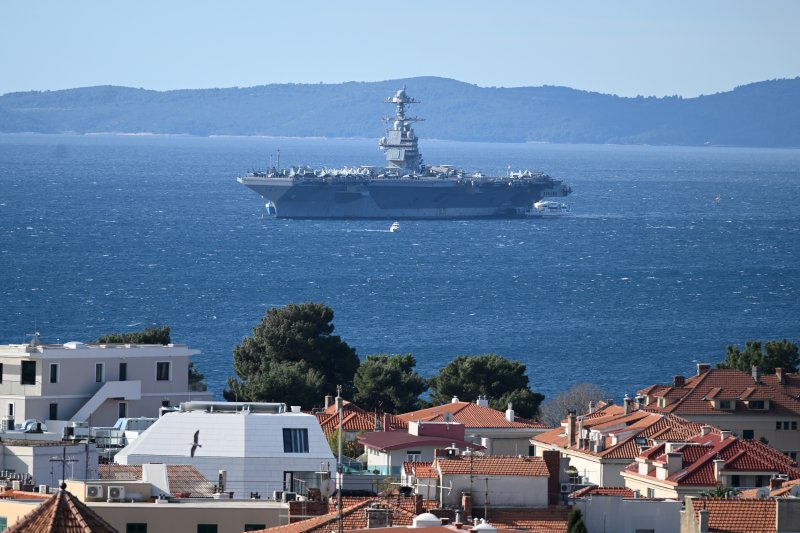
According to U.S. media reports on the 16th of last month, a major fire broke out in the laundry room of the USS Gerald R. Ford on the 12th while it was in the Red Sea. The carrier then left the front line and moved to a U.S. base on Crete in the Eastern Mediterranean. On the 28th of last month, the Ford entered the port of Split in the Republic of Croatia to begin full-scale repairs.
The USS George H.W. Bush is expected to replace the Ford and, together with the Lincoln, carry out strikes on the Islamic Republic of Iran. On the 31st of last month, United States Secretary of War Pete Hegseth warned at a press briefing that if the Islamic Republic of Iran does not agree to peace talks, the U.S. will further intensify its attacks. He said, “The Islamic Republic of Iran knows that the coming days will be decisive,” adding, “There is very little they can do militarily.” Hegseth stressed the denuclearization of the Islamic Republic of Iran and the abandonment of its nuclear materials, and declared, “If the Islamic Republic of Iran is not willing to reach an agreement, the United States Department of Defense (DoD) will continue attacks on the Islamic Republic of Iran with even greater intensity.” He went on, “We will negotiate with bombs.” It is already known that the U.S. has deployed about 5,000 Marines and roughly 2,000 Army paratroopers to the Middle East in preparation for possible ground combat with the Islamic Republic of Iran.
On the same day, Donald Trump spoke to reporters at the White House about the war with the Islamic Republic of Iran and said, “We will be leaving very soon.” Regarding the timing, he added, “Two weeks or three weeks.” He said it did not matter whether the Islamic Republic of Iran came to the negotiating table or not, because “we have pushed them back significantly.”
[email protected] Park Jong-won Reporter