"My annual salary is 60 million won — can I still get it?" Who gets the high oil price support and how much
- Input
- 2026-04-01 08:46:58
- Updated
- 2026-04-01 08:46:58
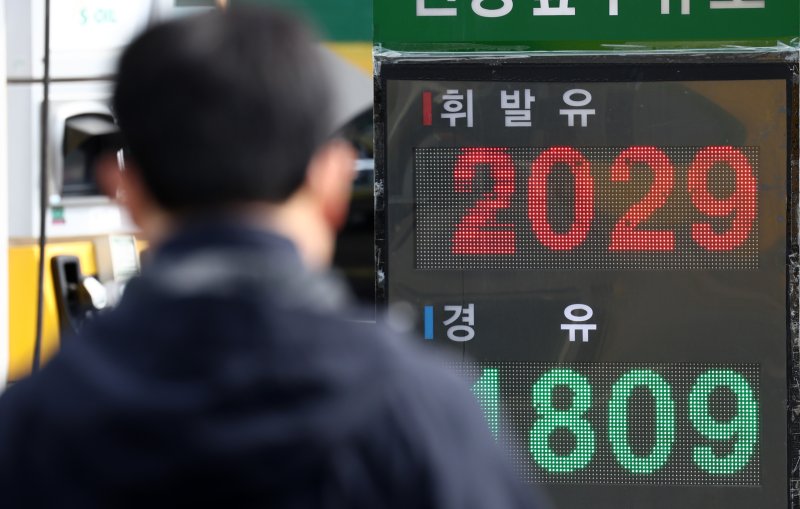
[Financial News] As the recent crisis in the Middle East drives up fuel costs, the government has prepared a High Oil Price Damage Relief Fund that can provide up to 600,000 won per person. This has drawn intense interest in who will qualify for the payments.
According to the Ministry of Planning and Budget on the 1st, the High Oil Price Damage Relief Fund totals 4.8 trillion won and will cover about 35.77 million people. The program includes the bottom 70% of income earners, or about 32.56 million people, as well as the near-poverty class and welfare recipients.
Even households earning 100 million won a year may be eligible
Because the support is financed through a supplementary budget, the eligibility range has been set more broadly than many expected. Based on typical health insurance contribution standards, salaried four-person households with an annual income of roughly 80 to 90 million won could fall within the scope.
According to a notice from the Ministry of Health and Welfare, the median income for a four-person household in 2026 is about 6.49 million won per month. Using this as a reference and applying standard estimates, some analysts say that households earning around 8 to 9 million won a month — close to 100 million won a year — could also be included.
The threshold also varies by household size. If converted to about 150% of median income on a monthly basis, the upper limit would be roughly 3.85 million won for a single-person household, 6.3 million won for two people, around 8 million won for three people, and about 9.7 million won for a four-person household.
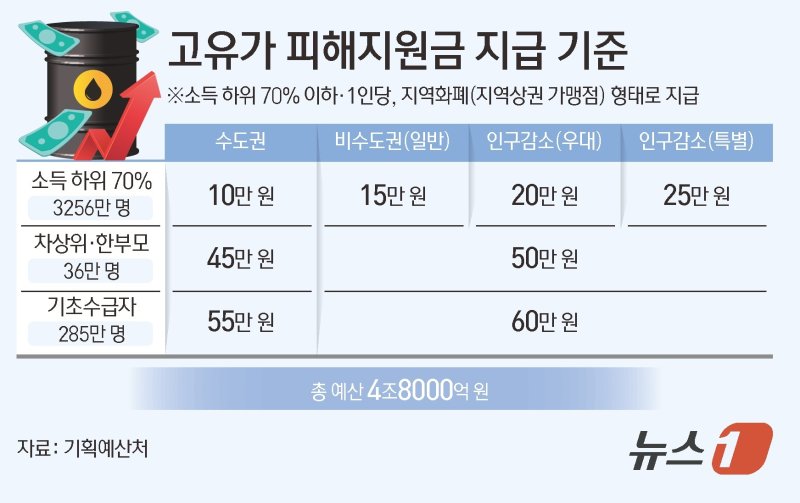
Amount varies by income and region... up to a 1.4 million won gap for a four-person household
The payment ranges from a minimum of 100,000 won to a maximum of 600,000 won per person, with the exact amount depending on income level and place of residence. The structure is designed so that people in the provinces and more vulnerable groups receive more. For ordinary households in the bottom 70% income bracket, residents of the Seoul metropolitan area will receive 100,000 won per person, those in non-metropolitan areas will get 150,000 won, and those in depopulation regions can receive up to 250,000 won.
Members of the near-poverty class and single-parent households will receive 450,000 won per person in the Seoul metropolitan area, while welfare recipients will get 550,000 won. The amounts are higher in non-metropolitan areas and depopulation regions. For a four-person household, this means ordinary households will receive between 400,000 won and about 1 million won, whereas welfare recipients can receive up to 2.4 million won.
To boost local consumption and revitalize neighborhood businesses, the support will be provided in the form of local currency. Payments will first go to welfare recipients and the near-poverty class. After that, additional payments will be made to the bottom 70% income group, determined mainly by health insurance contributions.
The actual payment schedule will depend on the National Assembly’s timetable. The government is aiming for a plenary vote on the 10th of this month, and if the schedule proceeds as planned, payments could begin as early as the end of this month or the beginning of next month. For last year’s Livelihood Recovery Consumption Coupon program, payments started about two weeks after the supplementary budget passed.
[email protected] Kim Hee-sun Reporter