President Lee’s secret card: What is the ‘Emergency Financial and Economic Executive Order’ that has lain dormant for 33 years?
- Input
- 2026-04-01 08:18:02
- Updated
- 2026-04-01 08:18:02
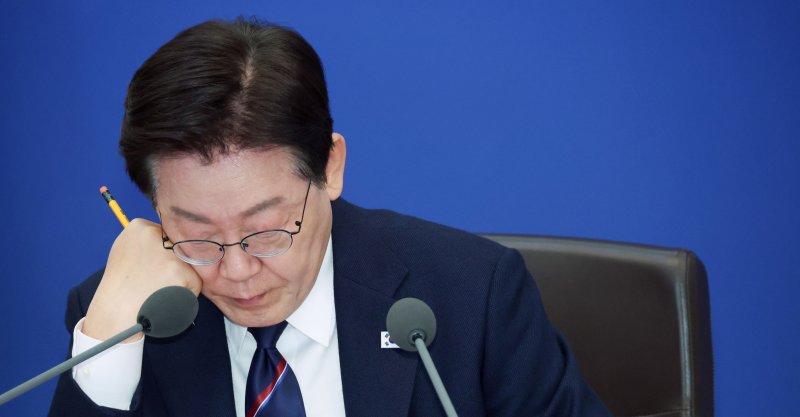
[The Financial News] President Lee Jae-myung has drawn attention by referring to the President’s authority to issue emergency financial and economic orders, a power explicitly stipulated in the Constitution. Some observers say it is unusual for Lee to bring up this provision at all.
During the State Council of South Korea meeting he chaired at Cheong Wa Dae (the Blue House) on March 31, Lee stated, "In urgent situations, we can make use of the Emergency Financial and Economic Executive Order provided for in the Constitution." His remarks came as the prolonged United States–Israel–Iran conflict and resulting Middle East shock have deepened the energy supply crisis.
His mention of the Emergency Financial and Economic Executive Order came in a concrete discussion of the current emergency phase. Lee said officials should not simply respond, "We can’t do it because the law doesn’t allow it," but instead study ways to overcome the limits of existing systems and statutes. He then added, "Isn’t there a system in the Constitution, the Emergency Financial and Economic Executive Order, that can even substitute for legislation?" In other words, he explicitly raised it as a tool that could bypass ordinary legal procedures if those procedures cannot keep pace with the speed required for crisis response.
Lee went on, "If necessary, we can revise laws, amend enforcement decrees, and change administrative guidelines. As long as an action is legally permissible, we can take it even if it departs from past practice." He added, "If there is any obstacle, do not cling to it within your own ministry. Bring it to the State Council of South Korea or to the Presidential Office. We will resolve it even through emergency legislation if we must."
What is the Emergency Financial and Economic Executive Order? The President’s emergency economic power that can bypass the National Assembly
Put simply, the Emergency Financial and Economic Executive Order is the President’s power to immediately issue an order that has the same effect as a statute, without going through the National Assembly.
It is an exclusive power of the President of the Republic of Korea set out in Article 76 of the Constitution. When there is an internal or external disturbance, a natural disaster, or a grave financial or economic crisis, and urgent action is required but there is no time to wait for the National Assembly to convene, the President may take the minimum necessary financial and economic measures or issue orders with the force of law on such matters.
However, the conditions for invoking this power are strict. The Constitution limits it to situations where urgent measures are needed and there is no time to wait for the National Assembly to meet. Although the President of the Republic of Korea can invoke it unilaterally, the measure is still subject to ex post control by the legislature. The Constitution also requires that it be reported to the National Assembly without delay and that the President obtain its approval. If the National Assembly does not grant approval, the measures or orders lose their effect from that point forward.
Only once under the current Constitution: the 1993 real-name financial system
There is historical precedent for the Emergency Financial and Economic Executive Order being invoked. Since the establishment of the government, a total of 16 emergency orders have been issued. Orders No. 1 through 14 were proclaimed during the Korean War, and under President Park Chung Hee during the First Oil Shock, the so-called August 3 Emergency Measure on Freezing Private Loans—which reduced interest on private loans and deferred debt repayment—was also implemented in the form of an Emergency Financial and Economic Executive Order.

Under the current constitutional framework, often referred to as the 1987 system, the Emergency Financial and Economic Executive Order has been used only once. The sole case is former President Kim Young-sam’s 1993 proclamation of the real-name financial system. At the time, the government prepared the measure under strict secrecy, fearing that if discussions in the National Assembly became public, illicit funds would flee overseas. Both the ruling and opposition parties were excluded from the decision-making process, and the move was carried out as a surprise.
Since then, no one has touched this emergency card for 33 years. During the height of Coronavirus disease 2019 (COVID-19) in 2020, under the Moon Jae-in administration, the possibility of invoking it was mentioned and reviewed, but it never progressed to an actual Emergency Financial and Economic Executive Order. This history helps explain why even within the ruling party there are differing views on whether it could realistically be used now.
Cheong Wa Dae (the Blue House) explained Lee’s latest remarks as an instruction for bureaucrats to actively consider every possible tool rather than remain bound by convention. Presidential Spokesperson Kang Yu-jeong said at a briefing that afternoon, "The point is that in an economic crisis or emergency situation, all policy instruments can be mobilized," cautioning against overinterpreting the comment.
In other words, this was not a declaration that an Emergency Financial and Economic Executive Order would be issued, but a call not to impose artificial limits on the government’s crisis response. Even so, some observers argue that the very fact that the President of the Republic of Korea explicitly cited this constitutional provision at a State Council of South Korea meeting is a signal of how seriously the administration views the Middle East shock and the resulting economic crisis.
[email protected] Kim Hee-sun Reporter