President Lee says "Emergency Financial and Economic Executive Order under review"... approves 26.2 trillion won war-related extra budget [26 trillion won high oil price supplementary budget]
- Input
- 2026-03-31 18:38:09
- Updated
- 2026-03-31 18:38:09
At the 13th meeting of the State Council of South Korea held at the main building of Cheong Wa Dae, the presidential office and residence of South Korea, President Lee said, "Each government ministry should closely monitor trends in its responsible items on a daily basis, and I ask you to respond preemptively and boldly to any signs of supply instability." He added, "If necessary, we should legislate, and we must exercise our authority and capabilities to the fullest." He went on to say there is a need to respond "as swiftly and boldly as possible," even mentioning the possibility of an Emergency Financial and Economic Executive Order.
The Emergency Financial and Economic Executive Order is an exclusive presidential power stipulated in Article 76 of the Constitution. It allows the president to issue orders with the force of law when urgent measures are needed due to "domestic unrest, foreign threats, natural disasters, or a grave financial or economic crisis," and there is no time to wait for the National Assembly of the Republic of Korea to act. Former president Kim Young-sam used this authority in 1993 when introducing the real-name financial system.
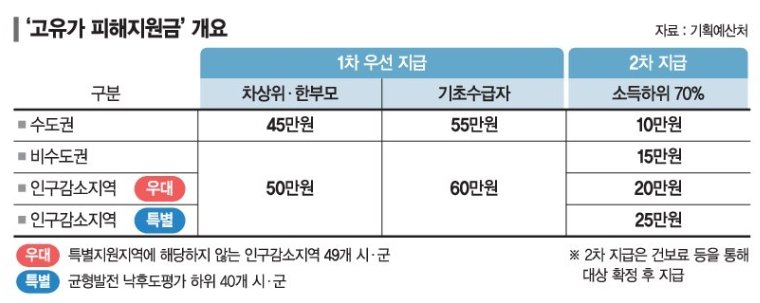
The supplementary budget bill approved by the government that day totals 26.2 trillion won. About 35.8 million people in the bottom 70% income bracket will receive between 100,000 and 600,000 won in high oil price relief in April, paid in local currency. The mechanism is the same as last autumn’s cost-of-living relief payments. The refund rate for public transportation fares paid with the K-Pass will also rise from 20% to 30% for the general public. More than 5 trillion won, the largest single allocation in this extra budget, will be injected to compensate losses under the oil price cap system, which the government implemented for the first time in 30 years. The government submitted the supplementary budget bill to the National Assembly of the Republic of Korea on the same day and aims for passage at a plenary session on the 10th.
This supplementary budget is fully funded without issuing deficit-financing government bonds, using surplus tax revenue generated by a boom in semiconductors and the stock market. It consists of 11.4 trillion won in corporate tax, 10.3 trillion won from the Securities Transaction Tax and the Special Tax for Rural Development, and 1 trillion won from the Tourism Promotion and Development Fund, totaling 26.2 trillion won.
The core of the extra budget is fiscal spending to "overcome the Middle East war crisis." The government has allocated 10.1 trillion won to respond to high oil prices, 2.8 trillion won for livelihood support, and 2.6 trillion won to assist companies affected by the Middle East war and to stabilize supply chains. In addition, 9.7 trillion won has been mandatorily allocated for the Local Grant Tax and Local Education Subsidy Grants.
west@fnnews.com