Stock market hit by triple ‘high’ risks; 5,000-point KOSPI level looks shaky in April [Exchange rate and stock market shockwave]
- Input
- 2026-03-31 18:38:07
- Updated
- 2026-03-31 18:38:07
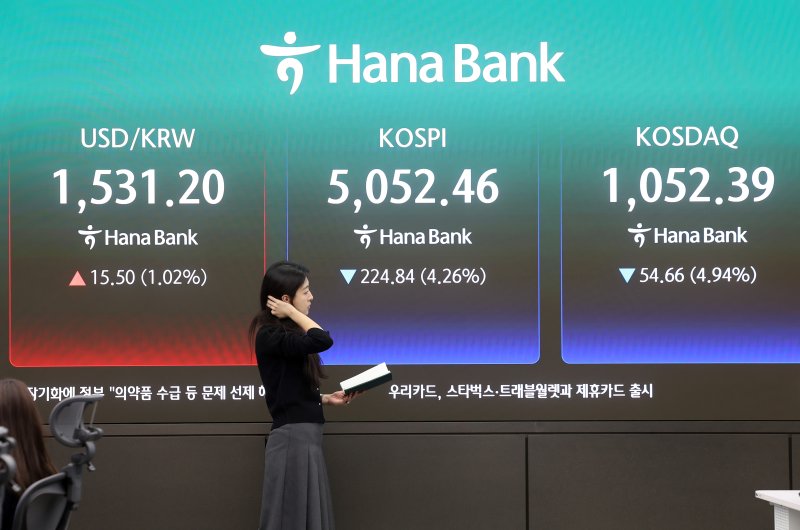
On the 31st, The Financial News surveyed six brokerage research centers—NH Investment & Securities, Shinhan Securities, KB Securities, Hana Securities, Samsung Securities, and Korea Investment & Securities—on their April stock market outlook. Four of them set the lower bound of their KOSPI forecast band below 5,000. NH Investment & Securities and KB Securities projected the lower end at 4,900, while Korea Investment & Securities and Samsung Securities suggested 4,700. That day, the KOSPI closed at 5,052.46, down 224.84 points (4.26%) from the previous session, sinking back to the 5,000 level for the first time since March 4 (5,093.54). Foreign investors, who have been net sellers for nine consecutive trading days, offloaded nearly 4 trillion won in shares, leading the index’s decline.
All the brokerages cited the combination of a weak currency, high oil prices, and high inflation triggered by the Middle East crisis as the biggest headwind. They warned that rising oil prices following the outbreak of war in the Middle East could intensify inflationary pressures and heighten the risk of interest rate hikes. On the 30th (local time), May futures for West Texas Intermediate crude oil (WTI) on the New York Mercantile Exchange (NYMEX) settled at $102.88 per barrel, up 3.25% from the previous session. It was the first time in three years and eight months, since July 2022, that WTI closed above $100 a barrel. On the same day, May Brent Crude Oil futures also rose 0.19% to close at $112.78.
The exchange rate also surged. The US Dollar–South Korean Won exchange rate ended the session at 1,530.1 won, up 14.4 won from the previous day. On a weekly trading basis, this is the first time the closing rate has broken above 1,530 won since March 9, 2009 (1,549 won), during the Global Financial Crisis (GFC).
Yoon Chang-yong, head of the research center at Shinhan Securities, said, “The triple ‘high’ phenomenon of a strong dollar, high oil prices, and high inflation, driven by geopolitical risks in the Middle East, is acting as the biggest negative factor, dampening investor sentiment.” He advised, “Rather than panic-selling out of fear as the index falls, investors should calmly restructure their portfolios around stocks with clear earnings visibility and wait patiently until volatility subsides.”
Kim Dong-won, head of the research center at KB Securities, warned, “With short-term volatility expanding, there is a risk that a bubble could burst at a time when monetary policy is tight and earnings growth is slowing.” He stressed, “Flexible responses based on rigorous risk management are essential.”
The prevailing view is that the domestic stock market still has ample room for medium- to long-term gains. This optimism stems not only from the government’s ongoing efforts since last year to reform and strengthen the capital market, but also from the continued growth of the AI industry. Although Google recently unveiled TurboQuant, a technology that dramatically reduces memory usage, some analysts argue that current concerns about a slowdown in memory semiconductor demand are overblown.
Seokmo Yoon, head of the research center at Samsung Securities, noted, “Geopolitical variables are increasing volatility, but if used well, they can become opportunities to boost returns.” He added, “Semiconductor stocks are volatile, but their earnings momentum remains solid, so they are likely to stay strong at least through the first half of the year. Global earnings momentum is still concentrated in IT, and the recent price correction has only increased their valuation appeal.”
A representative at the research center of NH Investment & Securities said, “After the emergence of TurboQuant, concerns about a slowdown in memory semiconductor demand have come to the fore. However, in the case of DeepSeek, a Chinese AI model, it improved memory efficiency through KV caching, yet actually leveraged longer context windows. Considering this, current worries are excessive,” adding, “Investors should also factor in the possibility of further upward revisions to aggregate KOSPI net profit after the upcoming preliminary earnings announcements from Samsung Electronics and SK hynix.”
Hwang Seung-taek, head of the research center at Hana Securities, said, “Profit growth and margin improvement led by semiconductors are expected to continue,” and went on, “Even during last year’s bull market, there were occasional corrections, but in hindsight those moments turned out to be buying opportunities. Therefore, a so-called ‘buy on dips’ strategy—accumulating when the index pulls back—could prove effective.”
Reporter Im Sang-hyeok (yimsh0214@fnnews.com)