KOSPI suffers its worst March ever as 1,000 trillion won in market value evaporates
- Input
- 2026-03-31 18:11:59
- Updated
- 2026-03-31 18:11:59
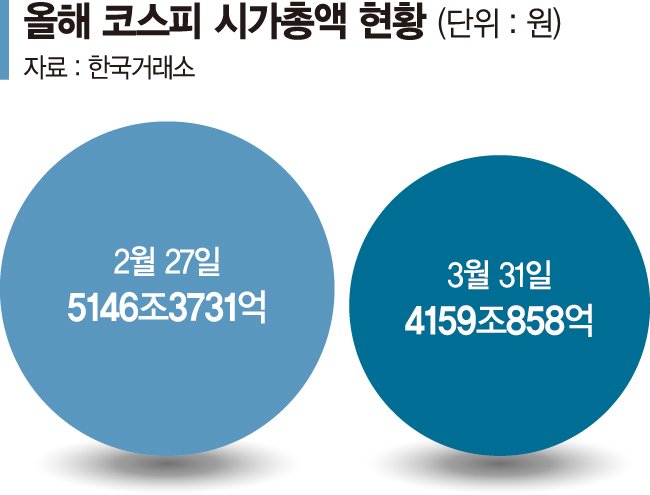
According to the Korea Exchange (KRX) on the 31st, the market capitalization of the main board in March stood at 4,159.858 trillion won. This is down 987.2873 trillion won from 5,146.3731 trillion won on February 27, the last trading day before the outbreak of the Middle East war.
This is the largest monthly decline on record. It far exceeds previous record drops, such as June 2022, when the domestic market slumped under the impact of weakness in the U.S. stock market and market cap fell by 278.2908 trillion won, and October 2018, when the China–United States trade war intensified and market cap shrank by 170.2156 trillion won.
In particular, the combined decline in market capitalization of Samsung Electronics and SK hynix, which lead the domestic stock market, reached 473.8646 trillion won, accounting for 48% of the total drop.
The near-1,000-trillion-won evaporation of market value in a single month reflects how the KOSPI, which had surged about 48% from the start of the year through late February, was shaken sharply once it was hit by geopolitical risks following the outbreak of war in the Middle East. The KOSPI started the year at 4,309.63 on January 2 and climbed to 6,244.13 on February 27, just before the war, setting the rare record of a 2,000-point jump in only two months.
Because the index had risen so rapidly, the subsequent decline was unusually steep. With war breaking out this month between the United States and Iran, every shift in global geopolitics amplified volatility in the domestic stock market. As the prolonged closure of the Strait of Hormuz pushed West Texas Intermediate crude oil (WTI) above 100 dollars per barrel for the first time since 2022, the won–dollar exchange rate also broke into the 1,530-won range, the highest level since the March 2009 financial crisis.
Amid these shocks, the KOSPI set new records for volatility in March. The sidecar mechanism, which temporarily halts program trading bids and offers and is designed to serve as a buffer during sharp market swings, was triggered seven times on the KOSPI alone. That is the highest number in 17 years and five months, since October 2008 during the global financial crisis, when it was activated 12 times. Sell-side sidecars were triggered on March 3, 4, 9, and 23, while buy-side sidecars were activated on March 5, 10, and 18. A sidecar is triggered when KOSPI 200 Index futures rise or fall by at least 5% from the previous day and stay at that level for one minute.
On March 4 and 9, the KOSPI even plunged more than 8%, triggering the circuit breaker mechanism that temporarily halts trading. It is the first time in six years that the circuit breaker mechanism has been activated twice in a single month on the KOSPI market, the last instance being in March 2020 during the COVID-19 pandemic. The KOSPI 200 Volatility Index (VKOSPI), often called Korea’s version of the fear gauge, also climbed intraday to 81.99 on March 5, its highest level since October 2008.
Experts believe volatility expanded further this month because the Middle East war erupted just as profit-taking demand was increasing after the sharp rally at the start of the year. They note that higher international oil prices and a stronger dollar–won exchange rate due to the war are unavoidable for the time being, but many expect the market to shift into an earnings-driven phase in April.
Kang Ja-in, Head of Domestic Equity Investment Division at ASSETPLUS Investment Management, explained, "Because the market had risen so sharply, the environment was already ripe for a correction, and the war in the Middle East unfortunately broke out on top of that, greatly magnifying the decline. As market anxiety grew, basket selling piled on, further increasing volatility." He added, "With the market having undergone a substantial correction this month and earnings season beginning in April, it is worth focusing on small and mid-cap stocks whose share prices have not risen sufficiently among companies that can back up their performance with solid earnings."
nodelay@fnnews.com Reporter Park Ji-yeon Reporter