Hyun-Song Shin plays down FX concerns: "Dollar liquidity is ample" [Summary]
- Input
- 2026-03-31 11:24:38
- Updated
- 2026-03-31 11:24:38
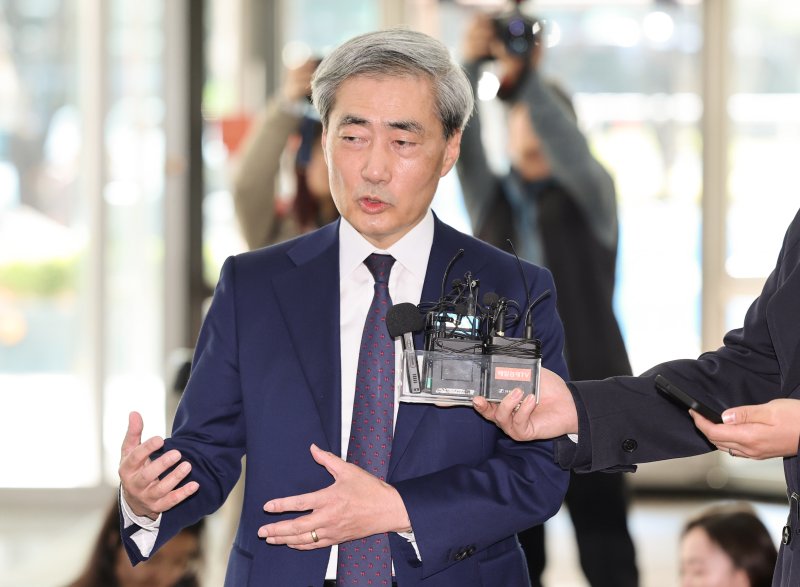
Speaking to reporters on his way into the confirmation hearing preparation office set up at Hanwha Finance Plaza in Jung District, Seoul, on the 31st, Shin said, "I do not attach great significance to the level of the (won–dollar) exchange rate itself," and added, "From the perspective of whether our financial system can absorb a certain degree of risk, I do not see major grounds for concern."
Shin went on to say, "If anything, indicators related to dollar liquidity are sound, so there is no need to directly link the exchange rate to financial instability as we did in the past," adding, "People generally worry about a shortage of dollar liquidity and capital outflows, but I think such external risks may not be that significant."
However, many analysts judge that the current exchange rate, which remains in the 1,500-won range, is out of line with South Korea’s economic fundamentals, and in that sense it is indeed at an abnormal level. A strong dollar and weak won hurt import-oriented companies, and even for exporters, it can be unfavorable for firms that must import raw materials for processing. On this day as well, the value of the won, which opened weaker against the dollar, touched 1,528 won during intraday trading.
For now, there are few effective tools available to ease exchange-rate pressures. The limited impact of verbal intervention has been confirmed in recent episodes, and there is not ample firepower for direct intervention. Because the country’s foreign exchange reserves must generate around 20 billion dollars a year in investment income for deployment in the United States, they cannot simply be drawn down at will to defend the currency.
Regarding the market’s characterization of him as a "pragmatic hawk," Shin commented, "This binary framing of hawks, who prefer tighter monetary policy, versus doves, who prefer easing, is not desirable." He emphasized, "It is important to read the overall flow of the economy, understand how the financial sector and the real economy interact at a system-wide level and what effects that produces, and then respond flexibly."
Asked about the future course of monetary policy, he replied, "We need to watch how the Middle East crisis unfolds and how long it will last, as there is considerable uncertainty," and added, "We also have to look at the monetary policy paths of advanced economies," declining to elaborate further.
He gave a positive assessment of the government’s push for a supplementary budget. Shin explained, "Because the Middle East crisis is intensifying difficulties for vulnerable sectors, it is necessary from a policy standpoint to mitigate those hardships," and added, "Judging from the size that has been announced so far, the impact on inflationary pressures should be limited."
Shin also said he does not see a high likelihood that the redemption turmoil in the U.S. private credit market, which began at Blue Owl Capital, will shake the broader financial system. "In terms of size, it is just under 2 trillion dollars, which is small compared with the banking sector," he noted. "Moreover, the main concern being raised is liquidity risk rather than default risk, and given its share within the overall financial system, it is not at a level that warrants serious alarm."
Private debt is a structure in which asset managers and similar institutions raise funds and then extend loans to companies from those funds. Major players in this market include Apollo Global Management, Kohlberg Kravis Roberts (KKR), and Blackstone. In South Korea, however, the market has yet to become fully developed.
taeil0808@fnnews.com Kim Tae-il Reporter