"Will it drop again?" How much foreign investors dumped Samsung Electronics and SK hynix — retail investors are on edge
- Input
- 2026-03-31 06:59:37
- Updated
- 2026-03-31 06:59:37
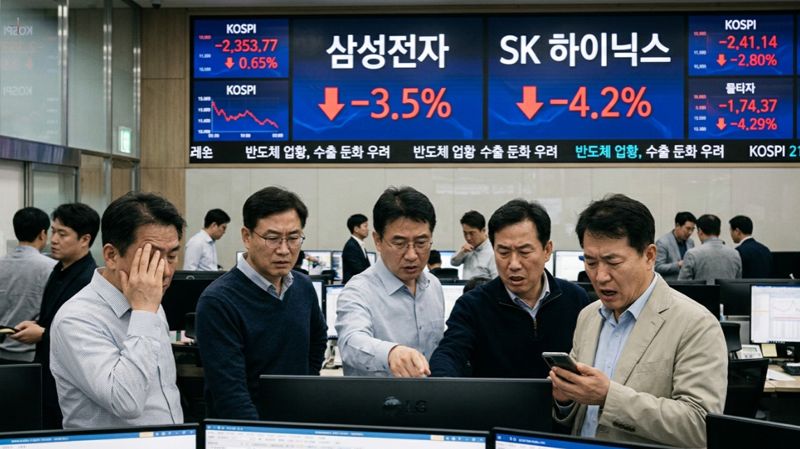
[The Financial News] Since the beginning of this month, foreign investors have been net sellers of more than 30 trillion won in the Korea Composite Stock Price Index (KOSPI) market alone, adding to supply-demand pressures. The stocks they sold the most were Samsung Electronics and SK hynix.
According to the Korea Exchange on the 31st, the KOSPI closed at 5,277.30 the previous day, down 161.57 points, or 2.97%, from the prior session. This decline was driven by heavy selling by foreign investors.
Foreign investors recorded net selling of 2.1335 trillion won in the Stock Market Division of the Korea Exchange alone the previous day. From the 19th through the previous session, they have continued net selling in the trillion-won range for eight consecutive trading days, further intensifying their selling.
In particular, after the war between the United States and Iran escalated in earnest, foreign selling has become even more pronounced. From the outbreak of the war through the previous day, their net selling in the KOSPI market reached 32.0686 trillion won.
This trend is seen as the result of a sharp deterioration in foreign investor sentiment, driven by heightened geopolitical risks, a surge in oil prices, and a rise in the US Dollar–South Korean Won exchange rate.
During this period, foreign investors’ selling pressure was concentrated on large-cap stocks at the top of the market capitalization rankings, such as semiconductor and automobile names.
The single stock that foreigners sold the most was Samsung Electronics, where they offloaded 17.6336 trillion won worth of shares. As a result, foreign ownership in Samsung Electronics fell to 48.7%, the lowest level in 10 years. SK hynix followed with 7.9208 trillion won in net selling, along with Hyundai Motor Company at 3.2913 trillion won and Kia at 968.2 billion won.
Some in the securities industry note that, because the concentration in specific sectors such as semiconductors remains severe, foreign investors’ selling for additional portfolio rebalancing could continue for the time being.
However, many also argue that it is difficult to interpret this trend solely as a pessimistic view of the Korean stock market. This is because the overall foreign ownership ratio is actually hovering around an all-time high.
Lee Sang-yeon, a researcher at Shinyoung Securities, noted, "The scale of foreign net selling in March amounts to only 0.69% of the KOSPI’s total market capitalization, so this is more a phase of profit-taking after short-term overheating than an exit from the market."
[email protected] Han Seung-gon Reporter