[Editorial] With the school-age population shrinking, it is reasonable to consider cutting the Local Education Grant
- Input
- 2026-03-30 19:20:14
- Updated
- 2026-03-30 19:20:14
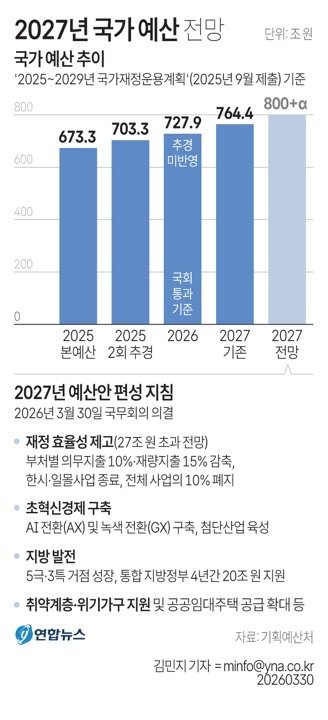
This year’s national budget is 728 trillion won and is expected to approach 800 trillion won next year. There is no shortage of areas that require funding, but considering the national debt, a large-scale expansion is difficult. The only real option is to allocate resources more efficiently, yet even that is not easy to adjust. In the end, the government appears to have concluded that the only part it can realistically adjust is mandatory spending.
A reduction in mandatory spending was discussed last year as well, and it has returned to the table this year. Mandatory spending covers items that are automatically disbursed under law or by formula, such as the National Pension Service (NPS), the Basic Pension, National Health Insurance, local allocation tax grants, and the Local Education Grant. Because legal revisions are unavoidable, the government has little discretion to cut these items on its own. Mandatory spending is expected to reach 415 trillion won next year and rise to 465 trillion won by 2029. Its share of the total budget is steadily increasing.
In practice, mandatory spending is very difficult to touch, but the government argues that it can be adjusted by changing the basic parameters. Pension reform under the principle of "pay more and receive less" in the National Pension Service is one such example. If mandatory spending is cut by 10%, more than 40 trillion won could be redirected to other areas. The problem is that most mandatory spending is related to welfare, and items such as local allocation tax grants and the Local Education Grant face strong resistance.
If the welfare sector is to be left untouched, the Local Education Grant ultimately has to be overhauled. The government has in fact singled out the Basic Pension and the Local Education Grant as targets. The Local Education Grant is automatically set at 20.79% of domestic tax revenues and therefore increases every year. The continued rise in the Local Education Grant despite a shrinking school-age population has been criticized many times. The Local Education Grant clearly deserves serious review.
The Basic Pension, which pays the same amount to everyone in the "bottom 70% income bracket," has also become an issue following recent remarks by President Lee Jae Myung. He suggested changing the system so that poorer seniors receive more. However, because he also implied that the total payout would remain unchanged, controversy is inevitable.
There is no shortage of demands on public funds, yet government debt is rising and the budget is limited. Ultimately, the only way forward is to resolve this through more efficient execution. The government’s decision to cut mandatory spending likely stems from this concern. Still, it must gather opinions from a wide range of groups, including stakeholders, before making decisions, in order to avoid backlash later.
The economy is almost certain to face greater difficulties next year because of the war in the Middle East. Tax revenues are likely to fall. There are numerous sectors that the state must support to foster growth, including advanced industries such as AI. The government also needs to invest in the regions to narrow regional disparities, and the list of areas requiring budgetary support keeps growing.
From the budgeting stage, spending on nonessential and less urgent projects should be postponed or restructured. The country cannot afford to keep wasting money on white-elephant infrastructure projects, such as underused regional airports. It is also common for the budget to be treated as easy money and squandered, leaking into unnecessary areas. The execution process of all projects must be closely examined to prevent such leakages.
Wasteful spending often arises during the National Assembly’s budget deliberations as well. A typical example is the so-called "note-passed" or "pork-barrel" earmarks that lawmakers secure for their own constituencies. Although this is an issue for a later stage, the behavior of lawmakers who focus solely on their districts without regard for the nation as a whole must also be corrected.