Stock market plunges in March... Will April bring a rebound or just a grind?
- Input
- 2026-03-31 06:00:00
- Updated
- 2026-03-31 06:00:00
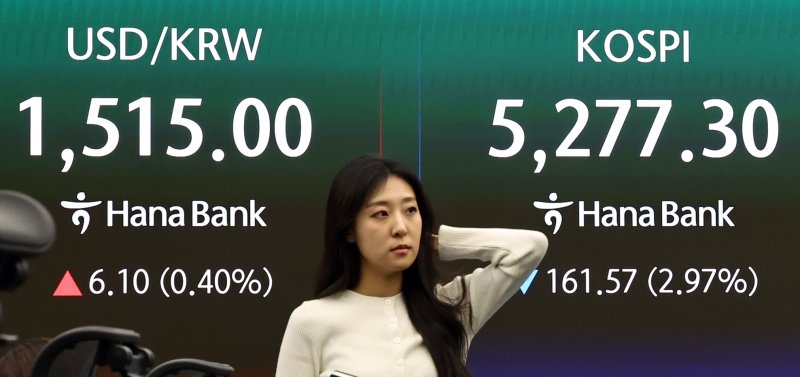
According to the Korea Exchange on the 31st, the previous day the KOSPI finished trading at 5,277.30, down 161.57 points (2.97%) from the prior session. The KOSDAQ (Korean Securities Dealers Automated Quotations) also fell 34.46 points (3.02%) to close at 1,107.05.
Over the past week (March 24–30), the KOSPI declined 2.8%, while the KOSDAQ managed to rise only 0.93%. For March as a whole, the KOSPI has dropped 15.48% and the KOSDAQ 7.19%, marking a sharp widening of losses.
On the flows side, foreign selling has been particularly pronounced. Over the past week, foreign investors were net sellers of 11.7902 trillion won in the KOSPI market and 110.6 billion won in the KOSDAQ. For March to date, they have offloaded a net 32.0685 trillion won on the KOSPI, while posting only 55.3 billion won in net buying on the KOSDAQ, highlighting a clear divergence between the two markets. Commentators say the combination of a weaker won and heightened geopolitical risk has dampened appetite for risk assets.
The macro environment is also weighing on equities. The US Dollar–South Korean Won exchange rate has climbed from 1,466.10 won at the start of the month to 1,515.7 won on the 30th, and international oil prices, with West Texas Intermediate (WTI) crude trading above 100 dollars per barrel, have surged sharply. Rising oil prices are stoking inflation expectations, which in turn are undermining hopes for interest rate cuts and increasing the discount rate applied to equities.
Uncertainty surrounding the semiconductor sector is another factor amplifying market volatility. Since Google unveiled its TurboQuant technology, which aims to streamline artificial intelligence (AI) models, investors have become more sensitive to the possibility of structural changes in memory demand, weakening sentiment toward related stocks. The resulting weakness in market leaders is seen as creating a structure in which the main index faces stronger downward pressure.
Against this backdrop, many expect the stock market in April to move within a range rather than establish a clear trend. Depending on developments in the Middle East conflict, the path of oil prices, and key economic data, the market may swing in the short term, but analysts say it is likely to repeatedly rise and fall within a certain band.
However, the recent correction has eased valuation pressures, leading some to argue that the KOSPI has entered a zone where its long-term price appeal is starting to stand out.
Joain, a researcher at Samsung Securities, said, "We should note that the recent price correction has increased the valuation appeal of the Korean stock market," adding, "Based on the 5,300 level for the KOSPI, the 12‐month forward price-to-earnings ratio (P/E ratio) stands at 8.4 times and the price-to-book ratio (P/B ratio) at 1.41 times. From a long-term perspective, the current price level can be seen as a zone where a certain degree of margin of safety has been secured."
koreanbae@fnnews.com Joain Bae Reporter