President Lee: "Energy situation so serious I lose sleep... swift transition to renewable energy"
- Input
- 2026-03-30 15:25:53
- Updated
- 2026-03-30 15:25:53
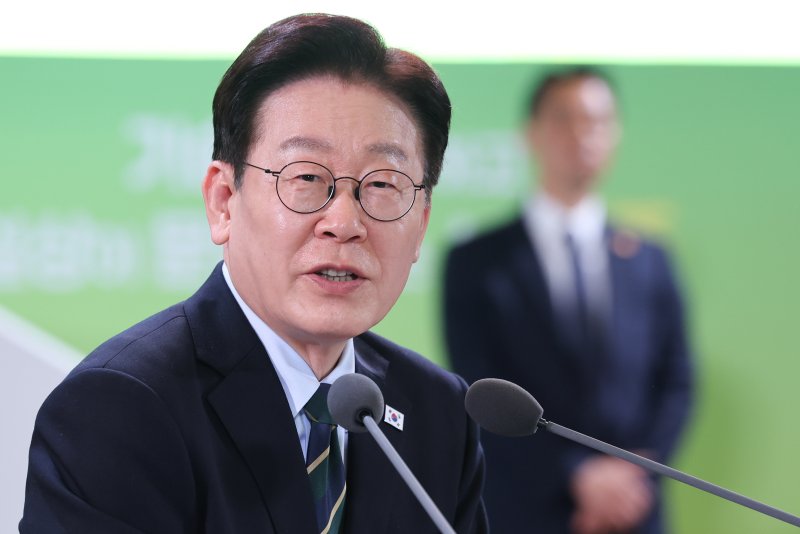
According to The Financial News, marking his 300th day in office, President Lee Jae-myung visited Jeju Island on the 30th and stressed, "South Korea as a whole must transition to renewable energy very quickly," adding, "If we continue to rely on fossil fuels, our future will be extremely dangerous." In particular, President Lee urged the Ministry of Climate, Energy and Environment to move up its target dates, criticizing the slow pace of converting internal combustion engine vehicles to electric cars.
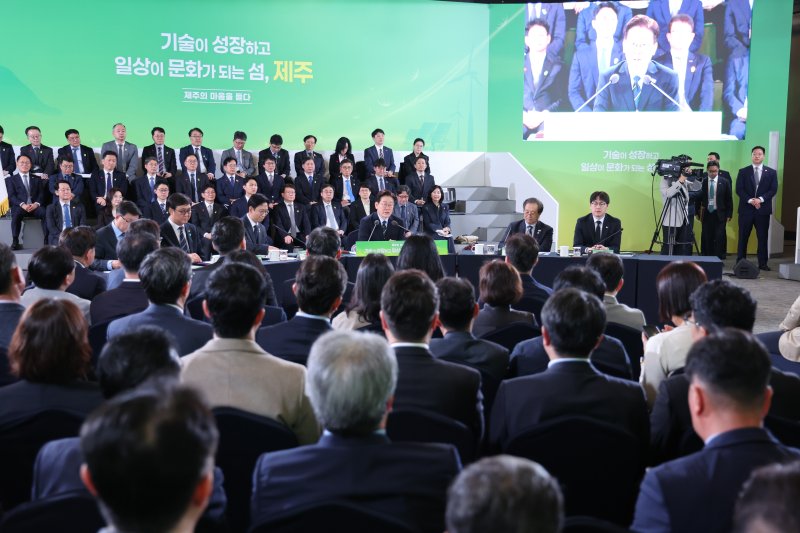
At the "Listening to the Heart of Jeju" town hall meeting held at Cheju Halla University that day, President Lee said, "We need to transition to renewable energy, and I believe Jeju Island is where we can achieve the most rapid and tangible results," reiterating this view.
President Lee noted, "The world is in turmoil over energy issues right now. The situation is so serious that I myself have trouble sleeping," and went on, "The problems we face today are grave, but the future looks even more unstable."
He continued, "This energy problem is something we were bound to face at some point, but Jeju is a rather special region. For example, it is not easy to depend on outside sources, yet it has enormous potential for natural renewable energy," calling on the island to move quickly toward a renewable energy transition.
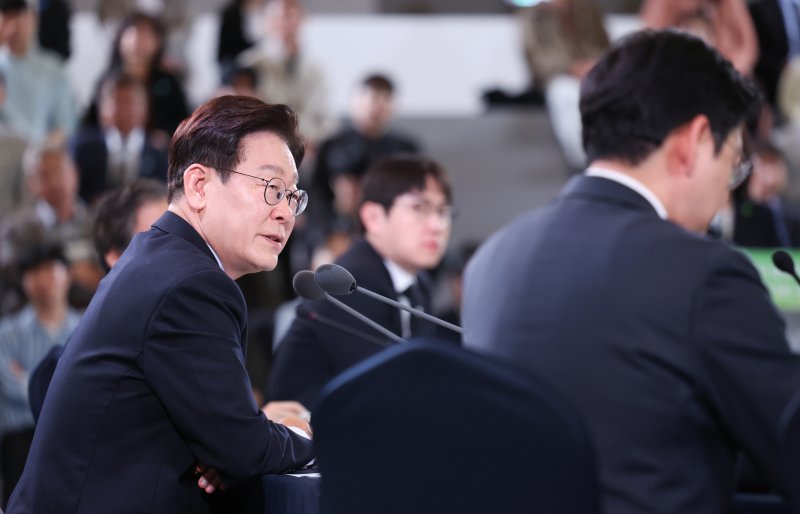
He also said that the spread of electric vehicles in Jeju should proceed faster than the central government’s original targets. After Kim Sung-hwan, Minister of Climate, Energy and Environment, reported a goal of making more than 50% of all new car sales electric by 2030 and 100% electric from 2035, President Lee asked detailed questions about the timeline for converting rental cars and remarked, "Why are we talking about another ten years? At this pace, when will it ever happen?" He then instructed, "We need to make it happen sooner." In response, Kim Sung-hwan replied, "We will work to make it happen faster."
President Lee emphasized, "Jeju Island is globally renowned for its natural scenery, and it should be exemplary when it comes to environmental conservation and protection. Yet there are still cars spewing exhaust fumes on the roads. When the central government takes the lead, it should move much more boldly and much faster than local governments. We need to be more aggressive." As of last year, the number of electric vehicles registered in Jeju had surpassed 40,000.
President Lee also reiterated, for a second day, his pledge to abolish the statute of limitations for criminal and civil liability in cases of state violence, in connection with the Jeju April 3 Incident. He said, "The best way to ensure that tragedies like the Jeju April 3 Incident, the Gwangju Uprising, and the December 3 Emergency Martial Law Incident never happen again is to eliminate statutes of limitations."
He went on, "We must abolish the criminal statute of limitations. As with Nazi war criminals, we must hold perpetrators accountable until they die. We should pursue, investigate, and prosecute them for life. Public officials must live with a sense of fear before history, the people, and the state," adding, "Within the scope of inherited property, let us hold their descendants responsible for generations. For crimes of state violence, we should also abolish the civil statute of limitations. That was my view."
He added, "This is an idea I have held for a very long time, and when I was party leader it finally took more concrete shape and passed the legislature, but it was nullified by a veto," while stressing, "Now I am president, the National Assembly holds a majority, and all three lawmakers from Jeju will surely agree wholeheartedly. It is time to act."
The day before, ahead of the 78th anniversary of the Jeju April 3 Incident, President Lee visited Jeju 4.3 Peace Park to pay his respects and met with bereaved families of the victims. On this day, he held the town hall meeting, a schedule arranged in consideration of upcoming summit diplomacy. On April 2–3, President of France Emmanuel Macron is scheduled to visit South Korea on a state visit, during which a summit with President Lee and other events will take place. President Lee remarked that day, "Because I have diplomatic events with the President of France, I came earlier."
Meanwhile, President Lee listened to participants’ views on the proposed undersea tunnel linking Jeju and the mainland. After asking the audience to raise their hands for or against the project, he observed, "The vast majority are opposed. There are far more people saying we should not do it," and added, "That is exactly how I feel." He continued, "Cautiously speaking, I think it is Jeju’s identity as an island that makes Jeju what it is," effectively voicing opposition to the undersea tunnel project.
He also asked participants whether they supported or opposed the Jeju Second Airport project, which has divided public opinion. When the responses appeared roughly evenly split, President Lee said, "It does not seem that one side is overwhelmingly dominant," and asked, "I hope you will judge the matter wisely."
cjk@fnnews.com Choi Jong-geun, Sung Seok-woo Reporter