KOSPI rebounds to the 5,270 level on institutional buying; KOSDAQ at 1,110 [fn Afternoon Market Briefing]
- Input
- 2026-03-30 14:37:26
- Updated
- 2026-03-30 14:37:26
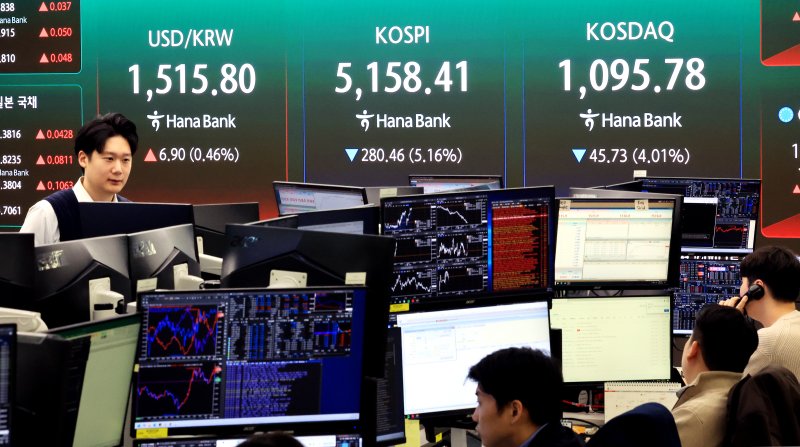
[Financial News] The Korea Composite Stock Price Index (KOSPI) recovered to the 5,270 level as institutional investors turned to net buyers, adding to continued net buying by retail investors.
According to the Korea Exchange (KRX) on the 30th, as of 2:31 p.m. the KOSPI was trading at 5,276.39, down 162.48 points (-2.99%) from the previous day. The index opened at 5,181.80, a drop of 4.73%, and at one point during the session fell as low as 5,151.22 (-5.29%).
In the main board market, retail investors and institutions were net buyers of 1.6293 trillion won and 264.3 billion won, respectively, while foreign investors were net sellers of 2.2614 trillion won.
By sector, only paper and wood products were in positive territory, up 0.52%. Securities (-6.47%), electric and gas utilities (-4.51%), and financials (-4.40%) were among the sectors posting declines.
Among large-cap stocks by market capitalization, LG Energy Solution (3.42%), Samsung SDI (2.10%), and LG Chem (3.19%) were strong. In contrast, SK Square (-6.43%), Mirae Asset Securities (-6.26%), and Hyundai Motor Company (-5.35%) were weak.
Major semiconductor stocks Samsung Electronics and SK hynix were down 2.06% and 4.66%, respectively. Following the announcement of TurboQuant technology, which is said to reduce memory semiconductor usage by up to sixfold, their share prices fell intraday to 170,600 won (-3.51%) and 862,000 won (-4.86%), but later pared some of those losses.
At the same time, KOSDAQ (Korean Securities Dealers Automated Quotations) was trading at 1,112.45, down 29.06 points (-2.55%) from the previous session. Retail investors were net buyers of 342.6 billion won, while foreign investors and institutions were net sellers of 187.5 billion won and 96.1 billion won, respectively.
Joain, a researcher at Samsung Securities, said, "Uncertainty over negotiations between the United States of America (U.S.) and the Islamic Republic of Iran continues, and with signs that the situation in the Middle East may escalate, investors should refrain from panic selling as we approach April 6, the second deadline set by Donald Trump." She added, "At the same time, it is important to note that the recent correction has made Korean equities more attractive in terms of valuation."
koreanbae@fnnews.com Bae Han-geul Reporter