Bitcoin Falls Below $70,000 as Oil, Rates and Regulatory Risks Sap Investor Sentiment [Crypto Briefing]
- Input
- 2026-03-30 14:32:02
- Updated
- 2026-03-30 14:32:02

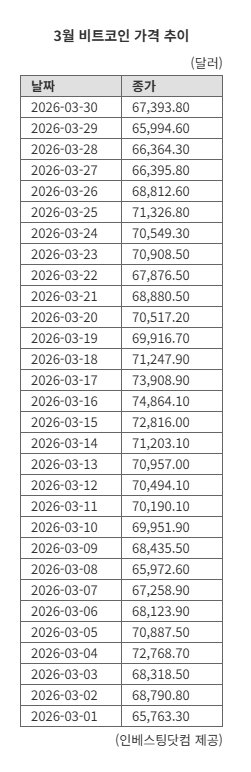
[Financial News] Bitcoin briefly dropped into the $65,000 range, and price volatility is widening. The surge in oil prices driven by tensions between the United States of America (US) and the Islamic Republic of Iran has increased uncertainty over the Federal Reserve System (the Fed)'s monetary policy path. At the same time, the United States Congress (US Congress) is pushing ahead with the Clarity Act, which now explicitly includes a ban on interest payments on Stablecoin holdings, adding further downward pressure on the market. Capital is also flowing out of Bitcoin Spot Exchange-Traded Fund (Bitcoin Spot ETF) products, heightening concerns about the sustainability of institutional demand.
According to Investing.com and industry sources on the 30th, the price of Bitcoin hit $73,900 on the 17th and then turned downward, sliding to the $65,000 range before attempting to hold support around $67,000. On the 26th and 27th, the daily decline widened to the mid-3% range, signaling stronger short-term correction pressure and weakening investor sentiment.
The biggest factor cited by the market is the changing macroeconomic environment. As the war in the Middle East drags on and concerns grow over a possible blockade of the Strait of Hormuz, Brent Crude Oil has climbed above $112 per barrel and West Texas Intermediate crude oil (WTI) has broken through $100. Ji-won Kim, a researcher at KB Securities, analyzed, "Fears of stagflation triggered by the spike in oil prices are weighing on US equities and risk assets across the board." Min-seung Kim, head of the Korbit Research Center, also observed, "If the probability of an April rate hike by the Fed rises above 20–30% due to surging oil prices, an additional price correction across risk assets, including Bitcoin, will be unavoidable."
Regulatory uncertainty is another factor shaking the market. The Clarity Act, a digital asset market structure bill under discussion in the US Congress, includes a provision banning interest payments on simple Stablecoin holdings, which is further dampening investor sentiment. Hong Jin-hyun, a researcher at Samsung Securities, pointed out, "The ban on interest payments shows a policy direction that seeks to limit Stablecoin to a payment infrastructure, rather than allowing it to function as a substitute for bank deposits."
On the supply-and-demand side, institutional investors are clearly taking a wait-and-see approach. According to SoSoValue, Bitcoin Spot ETF products saw about $350 million in net outflows during the week of the 23rd to the 27th. The strong inflows seen at the start of the year have paused, and the market is now experiencing alternating days of net inflows and net outflows. Over the same period, the simple average of the Coinbase Premium Index compiled by Coinglass stood at -0.05%. This index measures the price gap for Bitcoin between Coinbase and offshore exchanges and is used as an indicator of the strength of US institutional demand. A negative reading is interpreted as relatively weak buying interest from US institutions.
Even so, some themes and sectors have remained resilient amid the broader market correction. Data from Upbit Data Lab show that recent themes related to Artificial Intelligence (AI) have outperformed the overall market index, delivering relatively strong returns.
A source in the virtual asset industry said, "On blockchain-based, on-chain indicators, the growth of the AI agent ecosystem and of economies built on Real-World Asset (RWA) tokenization is still underway." The person added, "In the short term, volatility will remain high depending on macro variables, but the outlook for a structural rebound in the second half of the year is still intact."
elikim@fnnews.com Kim Mi-hee Reporter