"Even BYD Couldn't Hold Out"...China's Auto Market Shifts From Price to Technology
- Input
- 2026-03-30 08:58:25
- Updated
- 2026-03-30 08:58:25
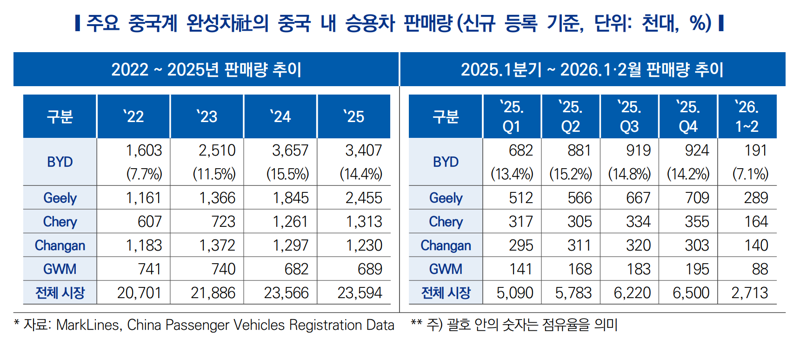
According to a report titled "Changes in China’s Automotive Competitive Landscape Signaled by BYD’s Weakness," published on the 30th by the Korea Automotive Technology Institute (KATECH), BYD’s annual market share climbed steeply from 7.7% in 2022 to 11.5% in 2023 and 15.5% in 2024. This was driven by a surge in sales from 1.603 million units in 2022 to 3.657 million units in 2024.
Last year, however, BYD’s sales fell to 3.407 million units, and its market share slipped to 14.4%. In particular, its share of China’s passenger car market shrank to 7.1%—191,000 units—in January and February this year, roughly half of its 14.4% share for all of last year. Over the same period, Geely Group sold 289,000 units, overtaking BYD to claim the top spot in the domestic market.
Lee Ho, a senior researcher at KATECH, stated, "The stagnation of BYD’s performance from late 2024 to 2025 is mainly due to intensifying cutthroat competition among manufacturers, the so-called ‘neijuan’ (involution)." He added, "The sudden plunge in sales in January and February this year reflects the impact of new policy measures introduced by the Chinese government to promote higher-quality growth in the auto industry, which in turn has weakened demand for small, low-priced vehicles."
In fact, starting this January, China upgraded its energy-efficiency standards for battery electric vehicles (BEVs) from the Recommended National Standards of China (GB/T) to the mandatory National Standards of the People's Republic of China (GB standards). Under the new regime, models that fail to meet the standards can be forced to halt production and sales, and companies may face fines as well as potential criminal liability for responsible executives.
Tax incentives have also been scaled back. The acquisition tax exemption for new energy vehicles, which had allowed a full exemption up to 30,000 yuan until 2025, has been cut in half this year. The minimum all-electric driving range requirement for plug-in hybrid electric vehicles (PHEVs) was raised from 43 kilometers to 100 kilometers—more than double—leaving many of BYD’s PHEV models ineligible for the benefit. In addition, the Vehicle and Equipment Replacement Subsidy Program, which supports the replacement of older vehicles, has shifted from a flat subsidy to one linked to vehicle price, a change that structurally disadvantages low-priced models favored by BYD.
The competitive environment has also deteriorated. BYD had led the market with its BYD Blade Battery and DM-i hybrid system, but rivals have narrowed the technology gap, and products have become more homogeneous, eroding its differentiation. BYD Chairman Wang Chuanfu himself acknowledged at an extraordinary shareholders’ meeting in December last year that weaker technological superiority and industry-wide product homogenization were key reasons for the company’s sluggish sales.
The report forecasts that around 2026, China’s auto industry will enter a full-fledged phase of restructuring. In the domestic market, it expects a reshuffle characterized by diverging fortunes across segments, greater emphasis on smart and autonomous driving features, and clearer differentiation between battery electric vehicles (BEVs) and PHEVs. At the industry level, it predicts accelerated restructuring, brand repositioning, and a simultaneous push for overseas expansion.
BYD has begun to fight back. In January this year, it announced plans to invest 100 billion yuan (about 21.8 trillion won) in intelligent vehicles. Earlier this month, it unveiled its second-generation BYD Blade Battery technology, which supports ultra-fast charging, along with plans to build out a domestic charging network. The company also revealed at NVIDIA GTC 2026 that it aims to mass-produce Level 4 autonomous vehicles using NVIDIA DRIVE Hyperion.
Lee Ho commented, "If the shock to the Chinese market persists, supplementary policy measures may eventually emerge, but for now the government is likely to remain in a wait-and-see mode." He projected, "Chinese automakers, including BYD, will respond to regulations while ramping up technology investment, and they will move even more aggressively to develop overseas markets."
[email protected] Kim Dong-chan Reporter