"There Won't Be Another Black Monday, Right?"... Korea Composite Stock Price Index (KOSPI) Down 12% in a Month as Retail Investors Mount a 'Last-Ditch Defense' [MZ Money Diary]
- Input
- 2026-03-30 07:10:30
- Updated
- 2026-03-30 07:10:30
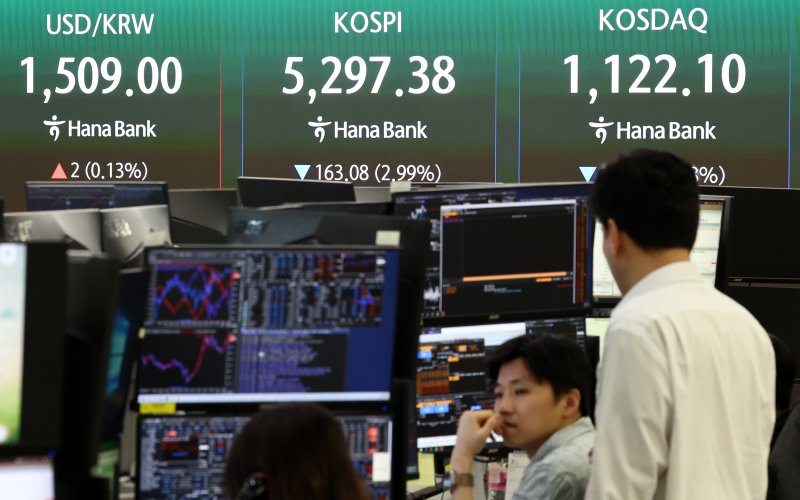
[The Financial News] Geopolitical risks are driving up volatility in the domestic stock market. This month alone, the KOSPI has fallen about 12%, ranking at the bottom among major markets. Attention is now on whether strong first-quarter earnings from leading stocks such as Samsung Electronics and SK hynix can become the key to a market rebound.
Soaring oil prices and exchange rates... KOSPI’s monthly return is among the worst globally
According to the Korea Exchange on the 29th, last week (March 23–27) the KOSPI closed at 5438.87, down 342.33 points (5.92%) from the previous week’s close of 5781.20. During this period, foreign investors and institutions were net sellers in the KOSPI market, offloading 13.5938 trillion won and 292.1 billion won respectively. In contrast, individual investors bought a net 12.2352 trillion won. As foreigners maintained a selling advantage for seven consecutive trading days, retail investors continued to step in and absorb the supply.
In the month since the Middle East risk flared up, the KOSPI’s return has plunged by around 12%. Initially, supported by expectations of a semiconductor industry recovery, the KOSPI had been firmly holding the top spot in terms of performance this year. However, as tensions between the US and the Islamic Republic of Iran pushed up oil prices and the exchange rate and stoked inflation concerns, its performance over the past month has fallen to nearly the worst level globally.
Last week, the market was shaken not only by geopolitical risks in the Middle East but also by the disclosure of Google’s 'TurboQuant' algorithm.
Market sees the 'TurboQuant shock' as a temporary blow
TurboQuant is a compression algorithm that can reduce the memory usage of a Large Language Model (LLM) by up to sixfold. Concerns spread that improved memory efficiency could dampen overall demand, which in turn hit the share prices of Samsung Electronics and SK hynix and became a negative factor for the broader domestic market.
Indeed, on the 26th, declines in these two top-cap stocks dragged the KOSPI lower. The foreign ownership ratio of Samsung Electronics fell to 48.9%, the lowest level in 12 years and six months.
The securities industry largely views the recent downturn as a temporary shock driven by external variables rather than a deterioration in corporate value.
Against this backdrop, the market is expected to remain highly volatile this week as well, depending on developments in the war. On this day, reports emerged that the United States Department of Defense (DoD) was preparing to deploy ground troops inside the Islamic Republic of Iran, while James David Vance, the Vice President of the United States, raised the possibility of an early withdrawal of US forces, sending mixed signals.
Experts expect the first-quarter earnings season to help put a floor under the market. Jongmin Kim, a Researcher at Samsung Securities, stated, "From around early April, when Samsung Electronics is scheduled to announce its first-quarter results, the market’s focus will shift from macro factors to corporate fundamentals," adding, "We recommend investors respond on a stock-by-stock basis, with a focus on semiconductors, which are leading the market."
hsg@fnnews.com Han Seung-gon Reporter