[Editorial] Vulnerable to External Shocks, the Korean Economy Cannot Delay an Across-the-Board Overhaul
- Input
- 2026-03-29 19:36:46
- Updated
- 2026-03-29 19:36:46
The fact that overseas institutions and investment banks are repeatedly lowering their growth forecasts for Korea must be taken seriously. The Organisation for Economic Co-operation and Development (OECD) recently kept its global growth outlook unchanged but slashed its forecast for Korean growth from 2.1% to 1.7%. By contrast, the US, which helped trigger the Middle East crisis, saw its projection raised by 0.3 percentage points. Japan and China, which are being hit by high oil prices in a way similar to Korea, did not see their previous figures revised. This means the economic shock from the war is particularly severe for Korea.
Global investment banks are moving in the same direction. Citigroup recently issued a report cutting its forecast for Korean growth by 0.2 percentage points, and Barclays and Goldman Sachs have also revised their projections downward. Earlier, the Woori Finance Management Research Institute projected that if oil prices remain above 100 dollars per barrel, Korea’s annual growth rate could fall by more than 0.5 percentage points. While growth is tumbling, prices are surging. The OECD raised its forecast for Korea’s inflation this year from 1.8% to 2.7%, a sharp increase of 0.9 percentage points. The fear of "stagflation"—a combination of high inflation and economic stagnation—could become a reality.
The impact of high oil prices is hard to gauge. Over the weekend, West Texas Intermediate crude oil (WTI) briefly climbed to 100 dollars per barrel, and Brent Crude Oil exceeded 110 dollars. Concerns about supply intensified after a Chinese vessel, seen as aligned with Iran, was blocked from passing through the Strait of Hormuz. On top of this, some warn that, just as Iran has effectively choked off the Strait of Hormuz, the Houthis could launch indiscriminate attacks on commercial ships passing through the narrow Bab-el-Mandeb Strait at the southern end of the Red Sea. It is a case of misfortune piling upon misfortune.
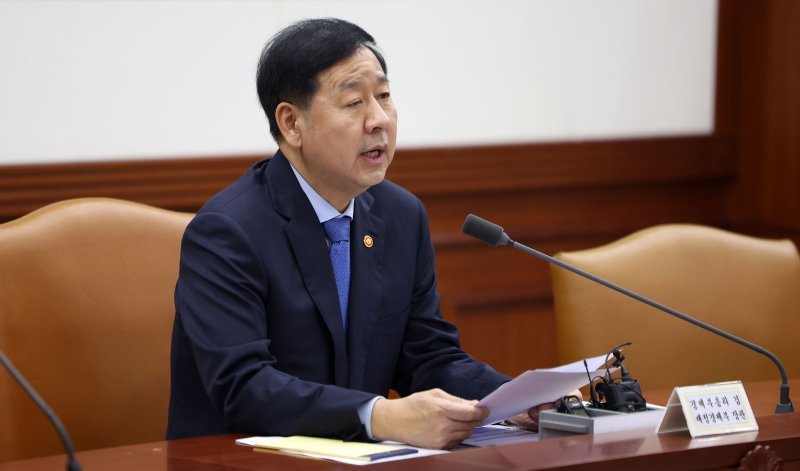
The solution will not be easy, but that is precisely why a comprehensive prescription is needed. Macquarie Group Limited has projected that if the war continues until June, oil prices could reach 200 dollars per barrel. Global oil companies are warning that even after the war involving Iran ends, elevated oil prices are likely to persist. Restoring the Middle East’s energy infrastructure to pre-war levels will take considerable time. Deputy Prime Minister and Minister of Finance and Economy Koo Yun-cheol has said that if international oil prices rise to the 120–130 dollar range per barrel, the government could extend the current five-day rotation driving restriction for vehicles to the private sector. Everyone needs to recognize the urgency of reducing energy consumption.
Beyond that, the government must thoroughly assess the current state of tangled supply chains, where risks are not properly diversified, and move quickly to craft response strategies. More than 70% of Korea’s crude oil imports come from the Middle East. A large share of industrial raw materials—including not only crude oil and gas but also naphtha, helium and urea—depends on specific regions. Warnings about the need to diversify supplies of critical minerals and raw materials have been raised countless times, yet once a crisis passes, nothing seems to change.
Korea should also work to raise productivity on the ground and actively consider expanding nuclear power, which is less exposed to geopolitical risks. Only by enduring painful but steady structural reforms and correcting deep-seated inefficiencies can the country build an economy capable of withstanding external crises.