Gasoline in Central Seoul Hits 2,000 Won... Truckers Say They Are "On the Verge of Shutting Off the Engine"
- Input
- 2026-03-29 19:21:47
- Updated
- 2026-03-29 19:21:47
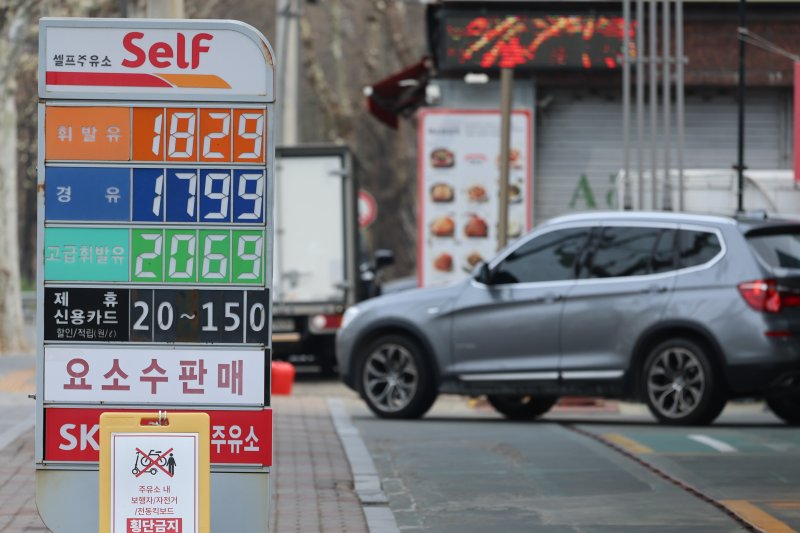
According to the Opinet oil price information system on the 29th, as of 1 p.m. the nationwide average gas station price per liter was 1,863.51 won for gasoline and 1,856.77 won for diesel, up 7.65 won and 6.81 won, respectively, from the previous day. Compared with the 26th, the day before the second-stage price ceiling took effect, when gasoline and diesel stood at 1,819.35 won and 1,815.80 won, prices have jumped by about 40 won in just three days.
Seoul, already known as the most expensive region in the country, recorded an average gasoline price of 1,913 won per liter, while diesel reached 1,892 won, on the verge of breaking the 1,900-won mark. In Jongno District, the average price of all fuel types has already surpassed 2,000 won. As a result, more and more vehicles are flocking to find even slightly cheaper gas stations. On the afternoon of the same day, a gas station in Ilsandong District, Goyang, Gyeonggi Province, where fuel was still available in the 1,700-won range, saw such a surge of cars that traffic was backed up for more than 10 minutes at one point.
Mr. Park (61), a driver of a large cargo truck, said, "Since the war, diesel prices have suddenly jumped by 200 to 300 won, and I no longer have the capacity to endure this," adding, "In just one month I spent about 1 million won more on fuel. Now more than half of my revenue will go to fuel costs, and once I factor in vehicle maintenance, at these 2,000-won levels I might have to turn off the engine altogether."
On the 27th, Mannamui Gwangjang Gas Station in Seocho District, Seoul, also experienced severe congestion as passenger cars, buses, and cargo trucks all tried to enter at once. Mr. Kim, a cargo truck owner in his 60s with 30 years of driving experience, said, "With fuel prices constantly rising, if I see anything in the 1,700–1,800 won range, I just fill up," and added, "Because of the cost burden these days, I only fill the tank halfway, but that is causing problems for long-distance trips." Mr. Kwak (49) also remarked, "In my seven years driving freight, I have never seen anything like this," and said, "I am basically working just to pay for fuel."
Industry observers largely believe that the recent upward trend in oil prices will not ease in the short term. A representative of the Korea Petroleum Association explained, "In the wake of the Middle East war, international oil prices have only just begun to be fully reflected in the domestic market, and if the war drags on, additional upward pressure on prices will be unavoidable." The representative added, "Because production facilities in oil-producing countries have been damaged, it could take considerable time to restore them, and it is uncertain whether prices will stabilize immediately even after the war ends."
Labor groups are urging the government to expand the truck safety freight rate system and fuel subsidies so that transport operators can maintain a stable livelihood. The truck safety freight rate system sets and announces minimum freight rates to prevent cargo truck drivers from speeding or overloading, thereby guaranteeing them a reasonable income. The government reinstated the system this year for the first time in three years, but labor groups argue that because it currently applies only to export and import container cargo and cement, 94% of freight workers are left out of its benefits.
Park Jae-ha, Policy Director of the Cargo Truckers Solidarity Division, noted, "Sharp spikes in oil prices are a phenomenon that recurs every few years," and stressed, "The fundamental solution is to immediately expand the truck safety freight rate system so that fluctuations in fuel prices are reflected in freight rates and the livelihoods of freight workers are protected." He also suggested, "The cap on the oil price-linked fuel subsidy, which is currently stuck in the 180-won-per-liter range, should be raised, and the payment threshold of 1,700 won should be lowered to reflect reality so that the support can have a real impact." At present, the government provides support for 70% of the amount by which the diesel price exceeds 1,700 won per liter.
psh@fnnews.com Park Seong-hyeon, Choi Seung-han, The Financial News