Koo Yun-cheol: "If international oil prices top $120, private cars will also face a five-day driving restriction"... Dubai crude nears $110
- Input
- 2026-03-29 12:59:22
- Updated
- 2026-03-29 12:59:22
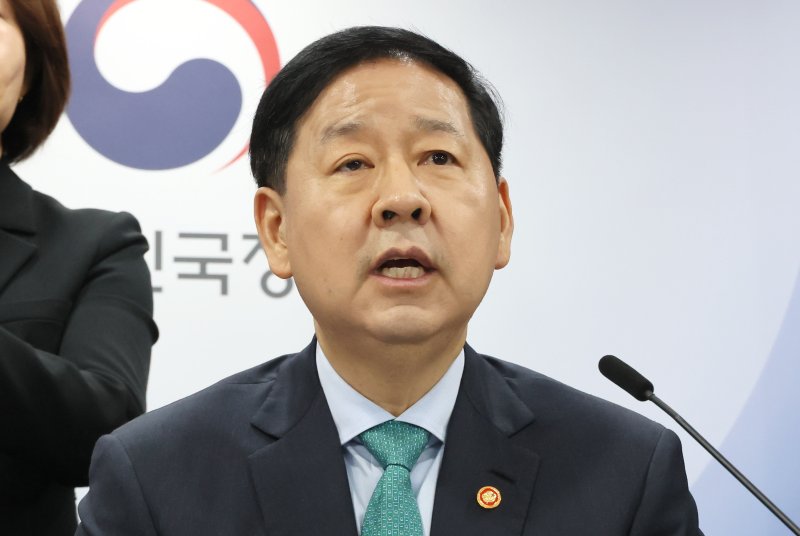
[Financial News] Deputy Prime Minister and Minister of Economy and Finance Koo Yun-cheol said on the 29th that if international oil prices surge above $120 per barrel, the government could expand the five-day rotation system for private vehicle use to the broader private sector.
Appearing on KBS Sunday Diagnosis Live that day, Koo said, "If the high oil price situation becomes more serious, the crisis level will have to be raised to around Stage 3 (alert)," adding, "At that point, we will need to curb consumption, and I believe we should ask for public cooperation and introduce a restriction system." He indicated that the currently voluntary five-day rotation system for private vehicles in the private sector could be made mandatory. As of the 27th, West Texas Intermediate (WTI) crude oil was at $99.64 per barrel, Dubai crude oil at $109.82, and Brent crude oil at $105.32, up more than 5% from the previous day at most.
Koo stressed that the government is doing everything it can to minimize the burden of high oil prices. He went on to say that, if necessary, the government could further cut fuel taxes and adjust the priority order for the use of naphtha, which is in short supply, among other measures.
He also said the government would accelerate the execution of the 25 trillion won supplementary budget.
Regarding the government’s supplementary budget proposal, Koo explained that support would focus on four main areas: responding to high oil prices; supporting livelihoods for small business owners, the self-employed, logistics and delivery workers, and young people; industrial support; and stabilizing supply chains.
Koo emphasized, however, that "this supplementary budget will be funded by expected excess tax revenue, and it will absolutely not be financed by new debt." Addressing concerns that high oil prices and a weak currency, combined with the supplementary budget, could further fuel inflation, he said, "According to the Bank of Korea (BOK), the impact on price increases is not expected to be large."
On the 15th, the BOK stated that the economy is so weak that real Gross Domestic Product is below potential Gross Domestic Product (GDP), and therefore even if the government injects money through a supplementary budget, it is unlikely that consumption or investment will rise sharply enough to significantly push up prices.
The US Dollar–South Korean Won exchange rate, which had stayed in the 1,400-won range, has now surpassed 1,500 won, dealing a blow to the real economy. In response, Koo said, "Korea’s foreign exchange reserves exceed about $420 billion, and our net external assets are around $900 billion," adding, "The kind of situation the public fears will not occur."
He also expressed confidence that the government’s measures to attract dollars and stabilize the exchange rate will bear fruit. Citing the Reshoring Investment Account (RIA), which offers temporary tax benefits to foreign investors returning to the domestic market, the inclusion in the World Government Bond Index (WGBI), which is expected to bring in more than $50 billion, and entry into the MSCI Developed Markets Index (DM Index), he said these three key exchange-rate response packages should gradually stabilize the won-dollar rate.
On speculation about a July overhaul of the real estate taxation system, including higher property holding taxes, Koo drew a line, saying, "We are still listening to a wide range of opinions, and nothing has been decided yet."
Koo also addressed the structural worsening of youth employment caused by changes in industrial structure, such as companies’ preference for experienced hires, rapid population aging, and the replacement of labor by artificial intelligence (AI). He said the government would announce Youth New Deal measures in April.
[email protected] Jung Sang-geun Reporter