G7 Issues Joint Statement Rejecting ‘Hormuz Transit Fee’ as South Korea Attends as Observer
- Input
- 2026-03-29 10:41:30
- Updated
- 2026-03-29 10:41:30
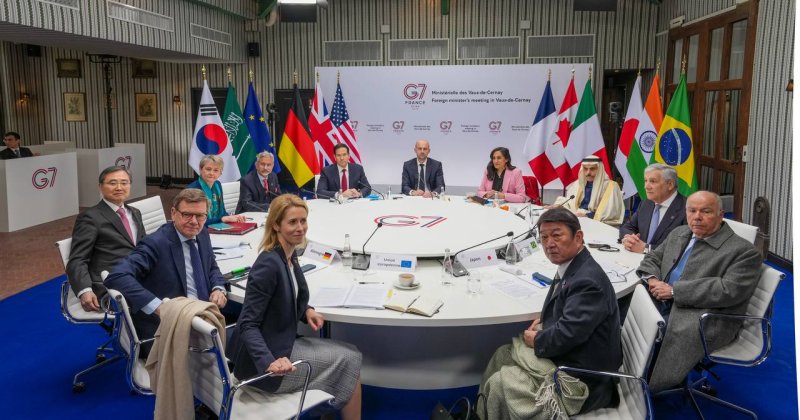
In its joint statement, the G7 Foreign Ministers’ Meeting reaffirmed the overriding need to "permanently restore safe, toll-free freedom of navigation in the Strait of Hormuz." It stressed that this position is in line with United Nations Security Council Resolution 2817, which condemns obstruction of navigation in the Strait of Hormuz, and with the law of the sea. Attending as an observer, Foreign Minister Cho Hyun said, "As we can see from the disruption of transit in the Strait of Hormuz caused by the current situation in the Middle East, maritime security is a core interest of the international community." Cho also held bilateral talks with representatives from eight key participating countries, including the United States of America (U.S.) and France, to discuss major pending issues.
Recently, the Islamic Republic of Iran has reportedly been preparing legislation to introduce a transit fee for the Strait of Hormuz. The Iranian parliament appears to be in the stage of reviewing and drafting a bill to authorize the collection of such fees and to formalize control over the strait.
There have also been reports that the Islamic Republic of Iran has already demanded a transit fee of about 3 billion won per vessel from some ships. The G7 Foreign Ministers’ Meeting further called for an immediate halt to attacks on civilian infrastructure and diplomatic facilities. South Korea, which took part in the meeting as an observer, supports this G7 joint statement.
Earlier, the Ministry of Foreign Affairs of the Republic of Korea joined, on the 20th, a "Joint Leaders’ Statement on the Strait of Hormuz" issued by seven countries: the United Kingdom (UK), France, Germany, Italy, Japan, Netherlands, and Canada. The ministry has stated that it will contribute to international efforts to ensure safe and free navigation in the Strait of Hormuz.
Meanwhile, separate from international coordination, the South Korean government and political circles have been directly engaging in diplomatic talks with the Islamic Republic of Iran to request the safety of Korean vessels. On the 23rd, the foreign ministers of South Korea and the Islamic Republic of Iran held a telephone conversation to discuss the Strait of Hormuz issue. In addition, on the 25th, the Foreign Affairs and Unification Committee of the National Assembly asked Saeed Koozechi, Ambassador of the Islamic Republic of Iran to the Republic of Korea, who visited the National Assembly Building in Yeouido, to ensure the safe passage of Korean ships stranded in the Strait of Hormuz.
In response, the Islamic Republic of Iran has stated through press briefings and other channels that ships from countries other than U.S. and Israel allies will be allowed to pass through the Strait of Hormuz. The Iranian side has also requested information on the 26 Korean vessels currently stuck in the strait. However, the Ministry of Foreign Affairs of the Republic of Korea has been cautious about providing such information, citing the fact that it has not yet received an official written assurance from the Iranian government guaranteeing the safety of Korean ships. About 180 Korean crew members are on board the 26 vessels isolated in the Strait of Hormuz. A ministry official noted, "The issue of the Strait of Hormuz involves a complex mix of factors, including the course of negotiations between the U.S. and the Islamic Republic of Iran and discussions in international bodies such as the United Nations and the International Maritime Organization (IMO)," adding that the government will closely examine all relevant circumstances and respond accordingly.
[email protected] Reporter Kim Kyung-soo Reporter