U.S. Stablecoin ‘Interest Ban’ Shock Spurs Circle to Seek a Turnaround Opportunity [Crypto Briefing]
- Input
- 2026-03-29 14:46:43
- Updated
- 2026-03-29 14:46:43

According to Financial News, the U.S. Congress has reached agreement on a key provision of the Digital Asset Market Clarity Act of 2025 (CLARITY Act of 2025) that bans Stablecoin issuers and platforms from paying interest or rewards. In response, shares of related companies, including Circle, the issuer of USD Coin (USDC), saw a sharp short-term decline. However, industry observers say the medium- to long-term growth outlook may actually improve, thanks to first-mover advantages in the emerging Artificial intelligence (AI) agent payments market.
As of the 29th, according to the virtual asset and financial investment industries, the new regulation is expected to serve as a moat that raises entry barriers for new competitors.
The CLARITY Act of 2025, which will establish a framework for the structure of the virtual asset market, has taken shape in a way that blocks direct interest payments to Stablecoin holders. In practice, this means Stablecoin issuers and platforms such as exchanges will not be allowed to pay users deposit rewards or interest. The move is seen as reflecting concerns from traditional financial institutions that bank deposit bases could be eroded.
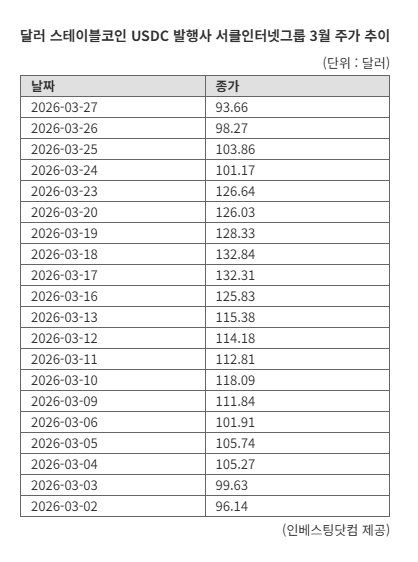
Markets reacted immediately. According to Investing.com, Circle (ticker: CRCL) plunged 20% on the 24th local time, when news of the compromise broke, falling to 101.17 dollars. The weakness continued, and by the close on the 27th the stock stood at 93.66 dollars, down roughly 30% from its recent short-term peak. Related names such as Coinbase (ticker: COIN) also suffered broad declines.
Even so, analysts judge that the practical impact of this “interest ban clause” on Circle will be limited. Hong Sung-uk, researcher at NH Investment & Securities, noted, “Unlike Coinbase, Circle has long operated under a structure where it does not pay interest on customer deposits,” adding, “In fact, the rule is likely to block the entry of latecomers that were trying to use interest payments as a weapon to gain market share.”
The existence of alternative revenue streams is also seen as a positive. Because the bill only bans “interest on simple holding,” analysts say investors can still earn returns by using Stablecoins to invest in tokenized financial products such as money market fund (MMF) tokens. This is expected to remain a key link supporting institutional demand for Stablecoins.
In fact, Circle’s market dominance has been strengthening. According to NH Investment & Securities, the circulation of USDC in the fourth quarter of last year reached 75.3 billion dollars, up 72% year-on-year, driven by surging demand for cross-border remittances. Its share of the Stablecoin market climbed to 28%, up 4 percentage points from a year earlier, while rival Tether (USDT) fell 5 percentage points to 69%, narrowing the gap.
Circle’s blockchain-based, AI agent–focused payment system “Arc” has also been highlighted as a core competitive asset. In the Business-to-Agent (B2A) market, where AI agents autonomously exchange value without human intervention, Stablecoins built on smart contracts have a decisive edge over traditional banking networks.
A virtual asset industry official said, “Share prices are swinging on short-term regulatory noise, but clearer rules are actually a starting signal for institutional capital inflows,” and stressed, “Rather than fixating on the negative of an interest ban, this is the time to focus on the expansion of real-world use cases where AI and blockchain are combined.”
[email protected] Kim Mi-hee Reporter