Won–dollar rate nears 1,490 won this month, 4th highest on record...largest drop among major currencies
- Input
- 2026-03-29 13:08:02
- Updated
- 2026-03-29 13:08:02
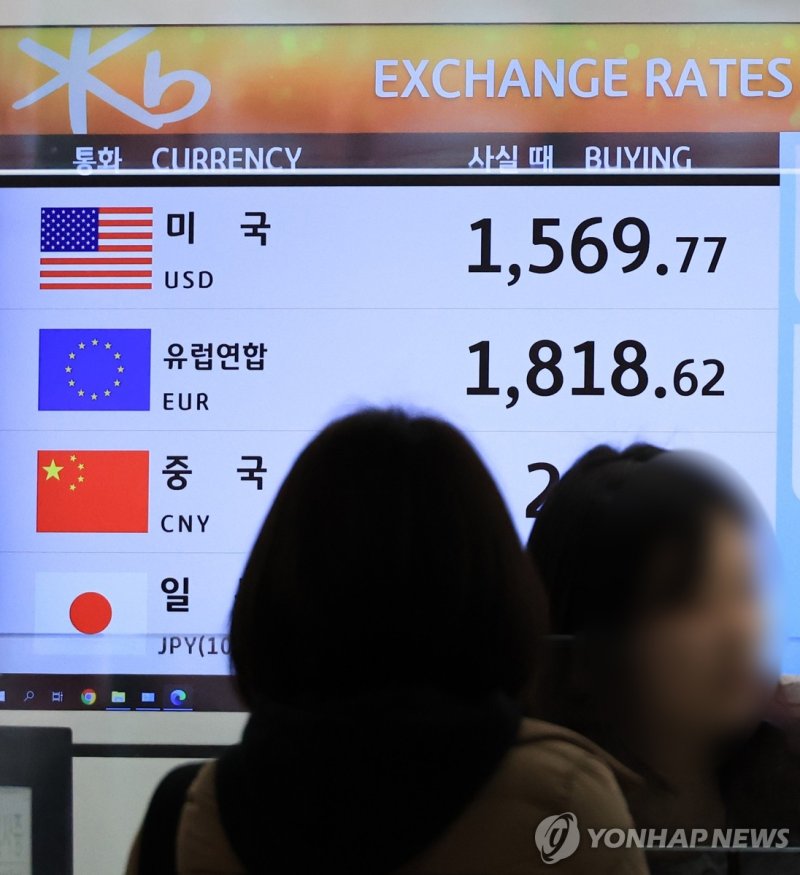
According to The Financial News, the average won–dollar exchange rate has climbed close to the 1,490-won level this month, marking the fourth-highest monthly level on record. Foreign investors’ net selling of Korea Composite Stock Price Index (KOSPI) shares has also reached about 30 trillion won so far this month, the largest amount ever. As the war in the Middle East heightens global risk aversion, foreign investors are dumping Korean stocks, driving the won weaker.
Data from the Bank of Korea (BOK) economic statistics system and Yonhap Infomax on the 29th show that the average exchange rate from the start of this month through the 27th, based on weekly closing prices, stood at 1,489.3 won. This surpasses the level seen in March 1998 (1,488.87 won) during the foreign exchange crisis, making it the fourth-highest monthly average on record.
The only higher monthly averages were recorded in December 1997 (1,499.38 won), January 1998 (1,701.53 won), and February 1998 (1,626.75 won), when the exchange rate surged right after Korea requested a bailout from the International Monetary Fund (IMF).
So far this year, the average exchange rate is 1,464.93 won, also the highest since the first quarter of 1998 (1,596.88 won), when the country was in the midst of the currency crisis. However, there is still a gap of about 130 won.
Last week, the exchange rate spiked at one point to above 1,517 won, pushing the weekly average to 1,503.4 won. On a weekly basis, this is the first time in 17 years that the rate has risen into the 1,500-won range, since the second week of March 2009 (1,504.43 won) during the global financial crisis.
From the start of this month through the 28th, the Korean won depreciated 4.72% against the U.S. dollar (based on New York closing prices), the steepest drop among major currencies.
Over the same period, the U.S. Dollar Index (DXY), which measures the dollar’s value against six major currencies, rose 2.6%.
All six currencies that make up the DXY—the European Union (EU) euro (-2.62%), Japanese yen (-2.58%), British pound (-1.64%), Swiss franc (-3.72%), Canadian dollar (-1.81%), and Swedish krona (-4.68%)—fell less than the won.
In Asia as well, the Australian dollar (AUD, -3.46%), New Taiwan dollar (NT$, -2.11%), and offshore Chinese yuan (CNH, -0.84%) all showed smaller declines than the won, meaning they were relatively stronger.
Only a few currencies, such as the Thai baht (-4.84%), Chilean peso (-5.48%), Russian ruble (-5.08%), and South African rand (-6.90%), weakened more than the won. On top of the shock from the Middle East war, foreign investors have been selling KOSPI shares for two consecutive months in record amounts, putting additional downward pressure on the won.
So far this month, foreign investors have recorded net selling of 29.8146 trillion won in KOSPI shares, surpassing the previous monthly record of 21.0599 trillion won set in March. Their combined net selling over the past two months exceeds 50 trillion won.
In just the past week, foreigners unloaded 13.3164 trillion won worth of Korean stocks. This is also the largest weekly net selling on record, exceeding the previous high of 11.7889 trillion won in the last week of February.
Last month, much of the foreign net selling came from investors taking profits in KOSPI stocks that had risen sharply earlier in the year. This month, however, the scale of net selling has grown as risk aversion stemming from the Middle East war has combined with concerns that the AI and semiconductor sectors may be overvalued.
Recently, Google unveiled a new technology that can reduce the memory required to run AI models by up to sixfold, dealing a blow to semiconductor stocks such as Samsung Electronics and SK hynix.
Lee Nak-won, FX derivatives specialist at NongHyup Bank (NH Bank), said, "Rising uncertainty surrounding the AI and semiconductor industries, along with overheating in our stock market, has contributed to the higher exchange rate." He added, "Although the outlook for semiconductors is still positive, in a risk-off environment driven by the Middle East war and rising market interest rates, portfolio adjustments by foreign investors are inevitable."
He went on to say, "Individual investors are net buyers of KOSPI shares and are supporting stock prices, which from the perspective of foreign investors creates favorable conditions for locking in profits."
Concerns about the Korean economy—given its high external dependence on energy and the large share of semiconductor exports—are also cited as a reason why foreign investors are pulling out of the domestic stock market.
Moon Jung-hee, chief economist at KB Kookmin Bank, explained, "Foreign investors continue to sell Korean stocks due to worries about an economy that relies heavily on Middle Eastern crude oil imports, a preference for safe assets, and efforts to avoid foreign-exchange losses amid fears of a weaker won." She added, "If the war leads to a global economic slowdown or to stagflation—rising prices during a downturn—the semiconductor cycle could also face a correction."
Even if the war in the Middle East, now in its second month, comes to an end, many analysts expect the weakness of the won to persist for a longer period.
Lee said, "Even after the war ends, elevated oil prices and higher inflation expectations will inevitably continue to weigh on the won by fueling concerns about an economic downturn." He projected that the exchange rate will fluctuate between 1,450 and 1,510 won in the second half of this year.
He also warned that if the United States deploys ground troops and the conflict escalates, the exchange rate could briefly surge past the 1,550-won level.
Park Hyung-jung, an economist at Woori Bank, commented, "If oil prices stay in the 120 to 130 dollar range, the equilibrium level of the exchange rate itself will shift to around 1,500 won." He continued, "Even if the war eases, the chances of the rate returning to previous levels are limited, and the annual average exchange rate is likely to be above the 1,450-won range, the highest in history."
Baek Seok-hyun, an economist at Shinhan Bank’s S&T Center, noted, "It will take years to restore damaged energy facilities in Gulf countries, and normalization of the Strait of Hormuz is also likely to be delayed." He said, "The likelihood that the exchange rate will remain in the 1,500-won range has increased significantly."
chlee1@fnnews.com Lee Chang-hoon Reporter