"Samsung Electronics and SK hynix Are Finished?" The Paradox of Google's TurboQuant: "In the End, AI Will Sweep Everything"
- Input
- 2026-03-29 05:00:00
- Updated
- 2026-03-29 05:00:00
[Financial News] Over the past week, a single term — "TurboQuant" — has shaken semiconductor stocks at home and abroad.
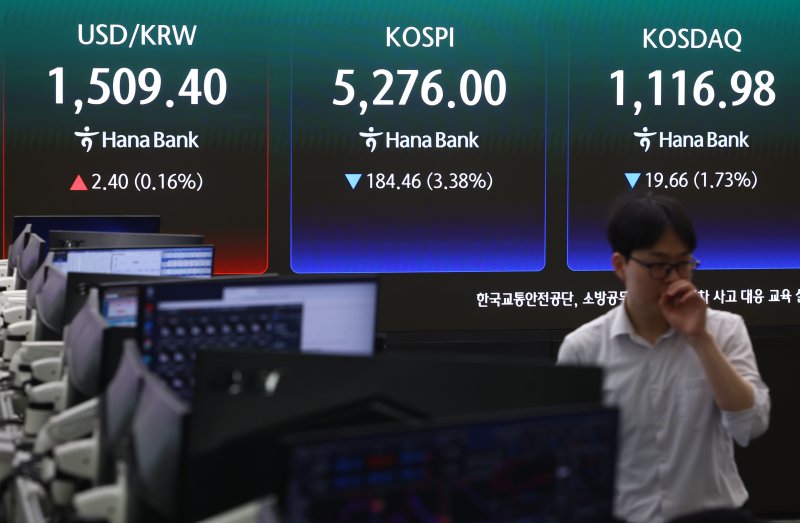
Since Google unveiled TurboQuant on the 25th, share prices of leading Korean semiconductor stocks such as Samsung Electronics and SK hynix have shown sharp volatility. On the 27th, Samsung Electronics closed at 179,700 won, down 0.22% from the previous session, while SK hynix fell 2.79% to finish at 922,000 won. Compared with the previous day (the 26th), when they plunged 4.71% and 6.23% respectively, both stocks ended the session with relatively smaller losses.
Panic selling early in the session briefly pushed the KOSPI below the 5,300 level. However, individual investors stepped in to buy more than 2 trillion won, helping to stem the index’s decline. Later, an announcement by U.S. President Donald Trump that he would postpone a deadline for attacking power plants in the Islamic Republic of Iran further eased market jitters, and the KOSPI eventually closed at 5,438.87.
One notable point is that foreign investors have been net sellers of 51.4557 trillion won since February, and Samsung Electronics and SK hynix together account for 72% of that amount, at 15.5586 trillion won and 6.3193 trillion won respectively. The foreign ownership ratio of Samsung Electronics has dropped to 48.90%, the lowest level in 12 years and six months since October 2013.
Why did the arrival of TurboQuant hit stock prices?
Market watchers largely attribute this backdrop to the emergence of TurboQuant. TurboQuant is a technology that boosts the efficiency of AI models by reducing memory usage. Its core is to compress, without degrading performance, the key-value cache (KV cache), a kind of "temporary memory" that large language models (Large Language Model (LLM)s) use to store previous conversation history.
According to Google’s research, the technology can cut memory usage to as little as one-sixth while increasing data processing speed by up to eightfold. The longer you converse with services like ChatGPT or Gemini, the more memory the AI must allocate to remember earlier parts of the dialogue. This "memory space" is the KV cache. For example, when a 70-billion-parameter LLM is used simultaneously by 512 users, the KV cache alone requires 512GB of memory.
TurboQuant mathematically compresses this space so that far more computation can be handled with the same amount of memory. As a result, concerns have emerged that memory demand could slow, which in turn has weighed on semiconductor share prices.
A Korean researcher on the core team: Professor Han Insu of KAIST
It has also drawn attention that the TurboQuant research team includes Professor Han Insu of Korea Advanced Institute of Science and Technology (KAIST), alongside Google researchers Amir Zandieh and Baharvand (Bahaab) Mirokni. Professor Han was a co-author on QJL (Quantized Johnson-Lindenstrauss Transform) and PolarQuant, which can be described as the heart of TurboQuant.
Professor Han entered KAIST as an undergraduate in 2010 and completed his PhD there in 2021. He was appointed as an assistant professor at KAIST in September 2024. His main research areas are artificial intelligence and machine learning, information theory, and coding theory. Since July last year, he has also been serving as a visiting researcher at Google Research.
“As AI models grow larger, the rapid increase in memory usage has been pointed out as their biggest limitation,” Professor Han explained. “This study proposes a new direction that can effectively ease this bottleneck while still maintaining accuracy.”
"Is TurboQuant a threat or an opportunity?" Diverging views on Wall Street and in Seoul
Professor Han predicted, "As AI shifts from a high-capacity paradigm to a high-efficiency paradigm, AI will become cheaper and spread more quickly, while semiconductor demand will also become more sophisticated in qualitative terms." Kwon Seokjoon, a professor of chemical engineering at Sungkyunkwan University, told Newsis, "If inference costs really fall sharply, the memory saved will be used for applications that were previously too expensive to run, and memory demand could actually grow even more explosively."
Brokerage houses are also invoking the Jevons paradox to support this view. The Jevons paradox, first observed by 19th-century British economist William Stanley Jevons, holds that when production efficiency improves and costs fall, demand can in fact surge rather than decline. Kim Dong-won, an analyst at KB Securities, likewise commented, "If TurboQuant lowers inference costs, it will accelerate the mass adoption of AI and act as a catalyst for an explosive increase in overall memory demand," calling the development a "long-term positive" for Samsung Electronics and SK hynix.
There are, however, dissenting views. Han Ji-young, an analyst at Kiwoom Securities, noted, "The stock shock from the DeepSeek episode did not even last a month, and AI demand expectations strengthened afterward." At the same time, Han cautioned, "We still need to watch whether the TurboQuant episode will replicate DeepSeek’s stock-price trajectory or mark the beginning of a new phase."
[email protected] Kim Hee-sun Reporter