A Power Market Without a Referee: Can the Electricity Commission Truly Become Independent? [Lee You-beom’s Eco & Energy column]
- Input
- 2026-03-28 06:00:00
- Updated
- 2026-03-28 06:00:00
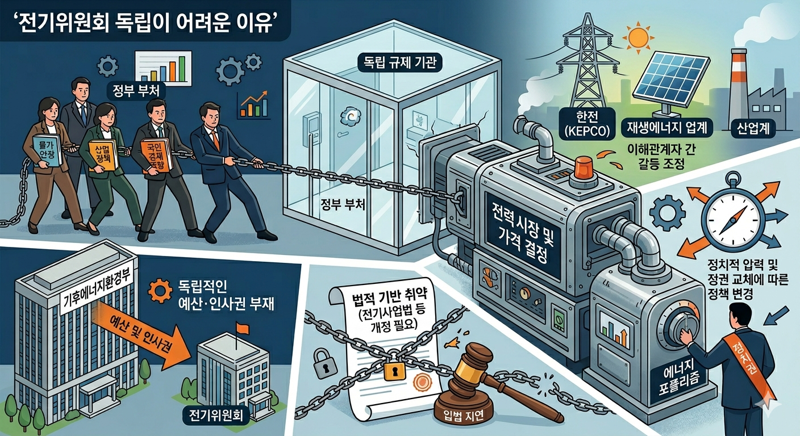
[The Financial News] From the very start of its term, the Lee Jae-myung administration has made strengthening the independence of the Electricity Commission a core energy agenda item. Its goal is to separate the authority to set the electricity bill from politics and shift to a system in which an independent body approves tariffs based on cost-reflective principles. The rhetoric is ambitious, but the hurdles are high. Legislative bottlenecks and structural conflicts of interest are holding back the Electricity Commission’s independence, and critics argue that the politically driven pledge of a regionally differentiated electricity tariff system actually runs counter to that very goal.
An Electricity Commission Reduced to a Mere "Rubber Stamp"
The Electricity Commission is a collegial administrative body tasked with fostering fair competition in the electricity industry, protecting the rights and interests of electricity users, and reviewing and approving electricity bills. Yet for decades it has been criticized as largely toothless in terms of real authority.
Under the current system, when Korea Electric Power Corporation applies to the competent ministry for a hike or cut in the electricity bill, the Electricity Commission reviews the proposal. The problem is that its conclusions are often not reflected in actual policy. Experts have long argued that this arrangement effectively reduces the commission to a mere reviewing agent, and calls are growing to grant it genuine decision-making power and dismantle the dual intervention structure involving the price-control authorities.
The Lee Jae-myung administration has announced plans to create the Ministry of Climate, Energy and Environment as a dedicated control tower and to grant the Electricity Commission "the authority to set the electricity bill based on objective cost verification." It also intends to establish an Electricity Supervisory Agency under the commission to strengthen ongoing oversight of market fairness, grid stability, and cost verification.
In December 2025, the government also carried out a personnel shake-up. Five new experts from fields such as electrical engineering, energy, and law were appointed to the commission. The Ministry of Climate, Energy and Environment stated that it expects them to play a key role in bolstering the Electricity Commission’s independence.
International comparisons also underscore the need for an independent regulator. In the United States, the Federal Energy Regulatory Commission (FERC) independently handles project approvals as well as monitoring and sanctioning in the electricity market, while the United Kingdom’s Office of Gas and Electricity Markets (Ofgem) performs similar functions. The government aims to launch the Electricity Supervisory Agency in the first half of 2027.
Legislation, Conflicts of Interest, and Appointment Controversies
The Electricity Commission’s independence cannot be achieved by declaration alone. Three structural barriers stand in the way. The first is legislation. Within the ruling party alone, three competing amendments to the Electric Utility Act are on the table. One would upgrade the commission to a central administrative agency under the Prime Minister of South Korea; another would expand its authority from review to full review-and-decision powers; a third would place it under the President of the Republic of Korea. The opposition has submitted its own bill to create a separate Energy Tariff Commission. Both sides of the aisle agree on the need for an independent regulator, but the Electricity Commission’s status and real powers will vary greatly depending on which blueprint passes. Conflicts of interest in the current structure have also come under fire. Article 43 of the Electric Utility Act stipulates that the rules for operating the electricity market are drafted directly by the Korea Power Exchange (KPX), which is itself a market participant. In other words, the players are writing the rules of the game. On top of that, the Director General for Energy Policy Bureau, Ministry of Climate, Energy and Environment concurrently serves as a standing member of the Electricity Commission, meaning a senior official from the very ministry being regulated also sits on the board of the supposedly independent body. This is a configuration rarely seen in independent regulators such as FERC or Ofgem. Personnel choices have sparked controversy as well. Among the new members appointed in December 2025 were an anti-nuclear activist with 30 years of experience, a lawyer who previously defended the President of the Republic of Korea in a criminal trial, and an attorney who served on the ruling party nomination management committee. These appointments have fueled accusations of "code-based" political hiring. Critics argue that appointing figures with such clear political ties, while claiming to strengthen independence, is self-contradictory and undermines confidence in the Electricity Commission’s autonomy from the outset.
A "Regionally Differentiated Tariff" That Undercuts the Push for an Independent Electricity Commission
Another key initiative of the Lee Jae-myung administration—the regionally differentiated electricity tariff system, or Locational Marginal Pricing (LMP)—is in a tense logical relationship with efforts to strengthen the Electricity Commission’s independence. On the surface, the scheme, which lowers tariffs in areas dense with power plants and raises them in consumption-heavy regions, appears to send cost-reflective price signals. But a closer look at its design shows that it is structured to pursue multiple policy goals at once: balanced regional development, energy transition, and compensation for communities that host power plants.
The crux of the problem is that this differentiated tariff scheme originated as a presidential campaign pledge. If the basic framework of the tariff—how regions are divided and which areas see cuts or hikes—is predetermined by a pledge, and the Electricity Commission is left only to sign off on the details, the independent regulator risks being reduced to a tool for legitimizing political decisions.
Notably, the regionally differentiated tariff system was originally slated to take effect in 2025, but its introduction was scrapped ahead of the 2026 local elections. Critics contend that the move reflected fears of a voter backlash over higher tariffs in the Seoul metropolitan area.
In the United States, FERC’s LMP system calculates regional prices by using algorithms to determine real-time transmission congestion costs. Because it is based on actual physical costs rather than political bargaining, the regionally differentiated tariffs run by an independent regulator there are fundamentally different in nature from the pledge-driven differentiated tariff scheme being pursued in Korea.
Some experts argue that the initial idea of dividing the country into just three zones—the Seoul metropolitan area, the rest of the country, and the Jeju region—and applying uniform tariffs within each is itself a political drawing of boundaries rather than a cost-based approach.
Efforts to strengthen the Electricity Commission’s independence and the regionally differentiated tariff system embody opposing logics when it comes to who should decide tariffs. The push for independence is premised on the idea that a professional body, insulated from politics, should set tariffs strictly according to cost principles. The differentiated tariff scheme, by contrast, starts from the view that prices should reflect policy goals such as balanced regional development and energy transition.
The two policy directions are not logically irreconcilable. Yet there is a clear internal tension in the way the Lee Jae-myung administration is currently pursuing them. For the Electricity Commission to become truly independent, the design principle of the differentiated tariff system must first be clarified: is it cost-based or policy-goal-based? Only when that principle is set not by Cheong Wa Dae (the Blue House) or a ministry, but by an independent body, can the two policies coexist without contradiction, analysts say.
With the launch of the Electricity Supervisory Agency scheduled for the first half of 2027, this is a critical moment for the Lee Jae-myung administration to back up its words with concrete and consistent follow-up measures. Only then can the Electricity Commission move beyond serving as a rubber-stamp body for political decisions and establish itself as a genuinely independent regulator.
Climate, environment, and energy are like two sides of the same coin. Depending on how energy is produced, it can accelerate global warming; conversely, changes in climate and the environment can reshape energy demand and supply.[Lee You-beom’s Eco & Energy column]This column, Lee You-beom’s Eco & Energy column, explores these inseparable issues of climate, environment, and energy every Saturday. Subscribe to the reporter’s page to receive it with ease.
leeyb@fnnews.com Lee You-beom Reporter