Government, ruling party weigh petrochemical export ban, vow to pass extra budget on April 9
- Input
- 2026-03-27 14:35:12
- Updated
- 2026-03-27 14:35:12
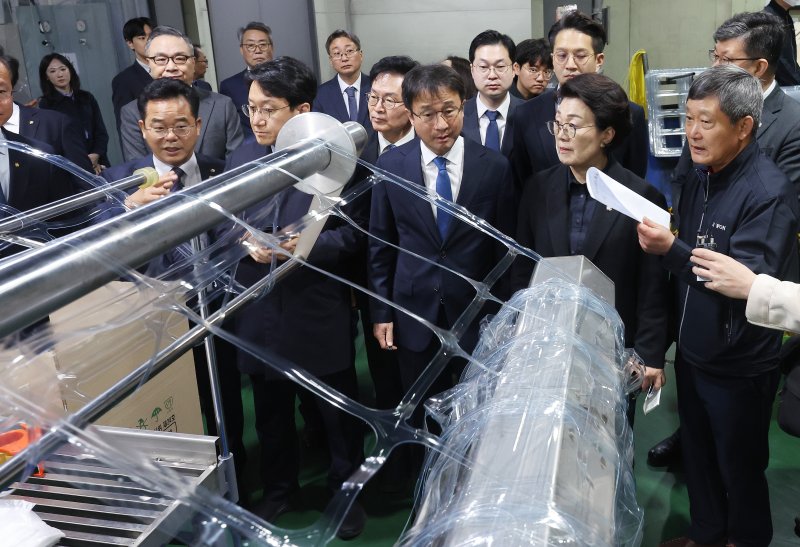
[Financial News] The Lee Jae-myung administration and the Democratic Party of Korea (DPK) on the 27th decided to consider banning exports of petrochemical products, in addition to Naphtha, in response to surging oil prices and raw material supply disruptions caused by the Iran war. They also reaffirmed their determination to have a supplementary budget bill to support export companies hit by the Middle East crisis passed by April 9.
Government and ruling party visit plastic firm, outline support measures including possible petrochemical export ban
On this day, Han Byung-do, the DPK floor leader, visited a plastic manufacturer in Gwangju, Gyeonggi Province, for an on-site meeting together with officials from the Ministry of Trade, Industry and Resources (MOTIR), the Ministry of SMEs and Startups, and other relevant ministries.
At the meeting, MOTIR raised the possibility of banning exports not only of Naphtha but also of petrochemical products. Park Dong-il, Director General for Industrial Policy at the Ministry of Trade, Industry and Energy, explained, "At the government level, exports of Naphtha have already been banned, and we are giving serious consideration to petrochemical products as well." He added, "The distribution channels for plastic packaging and containers are extremely complex, and the structure and types of products are highly diverse, so we are closely reviewing the issue."
The Ministry of SMEs and Startups (MSS) announced that starting next week it will examine the current state of consignment and subcontracting deals between major food and household goods companies and small and medium-sized plastic manufacturers. Lee Byeong-gwon, Second Vice Minister of SMEs and Startups, noted, "There may be cases where higher raw material costs are not reflected in prices, as well as other unfair practices." He continued, "We will launch a document-based investigation focusing on the Top five conglomerates in South Korea’s food, household goods, and beverage sectors that mainly engage in such consignment and subcontracting transactions, and then carry out on-site inspections and legal measures in accordance with legal procedures."
In addition, MOTIR proposed low-interest loans for petrochemical companies and expanding Letter of Credit (L/C) limits as support measures, while the Ministry of SMEs and Startups suggested providing emergency business stabilization funds for small and medium-sized enterprises. Regarding the supplementary budget that would include these funds, Han, the floor leader, expressed his intention to secure its passage in the National Assembly of the Republic of Korea by April 9.
Despite opposition criticism that the extra budget will fuel inflation and serve as vote-buying ahead of local elections, Han Byung-do vows to "pass it on April 9"
Referring to the previous day’s party-government consultation on the supplementary budget, where they agreed to include funding to cover the price gap for alternative Naphtha imports, Han said, "We understand that instability in the supply of Naphtha, often called the ‘rice of industry,’ has created a strong sense of crisis in the plastics sector." He stressed, "Once the government’s proposal is submitted to the National Assembly of the Republic of Korea on the 31st, the message from the field is that all standing committees should be convened and the budget injected immediately, even if it means working through the night. We will pass the supplementary budget on the 9th to respond swiftly to this urgent crisis."
Han then criticized the People Power Party (PPP) for suggesting during negotiations at the National Assembly’s Special Committee on Budget and Accounts that the supplementary budget should be handled on the 16th of next month because the parliamentary interpellation session should come first. He asked pointedly, "I do not understand why the interpellation session is more urgent than the swift injection of a supplementary budget in an emergency."
The People Power Party argues that a plenary vote in the National Assembly of the Republic of Korea on the 16th of next month would not be too late, and, given the urgency, has suggested that the schedule could be moved up to the 14th. Since the key issue is whether to proceed with the parliamentary interpellation session, they insist that Speaker of the National Assembly Woo Won-shik and the floor leaders of the ruling and opposition parties should meet next week to make a final decision. This stance is rooted in their view that a supplementary budget is not the right solution to the Middle East crisis. They warn that inflationary pressure from surging oil prices could be further stoked by an extra budget, and argue that, because it includes funding for local currency-based livelihood support, it effectively amounts to "vote-buying" ahead of the local elections.
The Democratic Party of Korea counters that, considering the supplementary budget procedures that local government bodies must complete to execute the funds, the bill needs to clear the National Assembly of the Republic of Korea by April 9. With the June local elections approaching, the final sessions of many local councils are not far off, raising the risk that implementation of the supplementary budget could be significantly delayed. The party also warns that if support to offset the import price gap for Naphtha is delayed, the situation of the petrochemical industry, already under severe strain, could deteriorate further. In that case, they caution, supply disruptions could spread to everyday plastic necessities such as volume-based trash bags, leading to greater public confusion.
uknow@fnnews.com Kim Yun-ho Reporter