Clash Begins Over Supplementary Budget Review Schedule... Ruling Party Insists on April 9 Passage
- Input
- 2026-03-27 12:29:25
- Updated
- 2026-03-27 12:29:25
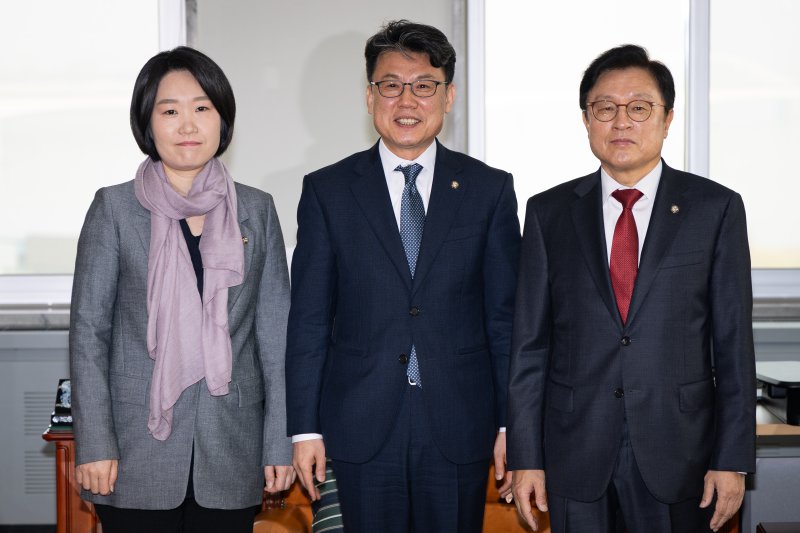
[Financial News] The Lee Jae-myung administration is expected to submit a supplementary budget bill worth 25 trillion won to the National Assembly of the Republic of Korea on the 31st to respond to the surge in oil prices caused by the Iran war. Even at their first talks on the review schedule for the supplementary budget on the 25th, the ruling and opposition parties were already locking horns. The Democratic Party of Korea (DPK) argues that, given the urgency, the bill must clear the National Assembly by April 9, while the People Power Party (PPP) insists that the plenary interpellation session with the government should be held first and the supplementary budget reviewed afterward.
On that day, the Special Committee on Budget and Accounts of the National Assembly held a meeting where Chair Jin Sung-joon and committee secretaries Lee So-young of the DPK and Park Hyeong-su of the PPP discussed the timetable for reviewing the supplementary budget. However, the two sides failed to reach an agreement. The DPK requested a schedule that would allow a vote at a plenary session of the National Assembly on April 9, while the PPP proposed a timeline targeting April 16, after holding the plenary interpellation session with the government first.
The DPK contends that, in order for local governments to carry out their own supplementary budget procedures and execute the funds, the bill must pass the National Assembly by April 9. With the June local elections approaching, the final sessions of many local councils are not far off, raising concerns that implementation of the supplementary budget could be significantly delayed.
The party also warned that if execution of the supplementary budget is delayed, support to offset import cost gaps and curb soaring Naphtha prices will be pushed back, further worsening the already dire situation facing the petrochemical industry. In that scenario, they cautioned, supply disruptions could spread to everyday plastic necessities such as volume-based garbage bags used for household waste, leading to broader public confusion.
The PPP counters that putting the bill to a vote at a plenary session of the National Assembly on April 16 would not be too late, and suggested that, in light of the urgency, the date could even be moved up to April 14. Since the key sticking point is whether to hold the plenary interpellation session with the government, the party argues that Speaker of the National Assembly Woo Won-shik and the floor leaders of the ruling and opposition parties should meet next week to settle the matter.
Fundamentally, the PPP maintains that a supplementary budget is not the right solution to the Middle East crisis. The party warns that inflationary pressure from higher oil prices could be further fueled by additional fiscal spending. It also criticizes the inclusion of funding for local currency livelihood support payments, arguing that this effectively amounts to a vote-buying scheme ahead of the local elections.
uknow@fnnews.com Kim Yun-ho and Song Ji-won Reporter