"Era of 2,000-won gasoline" likely to arrive...Maximum oil prices to be sharply raised from the 27th
- Input
- 2026-03-27 06:06:45
- Updated
- 2026-03-27 06:06:45
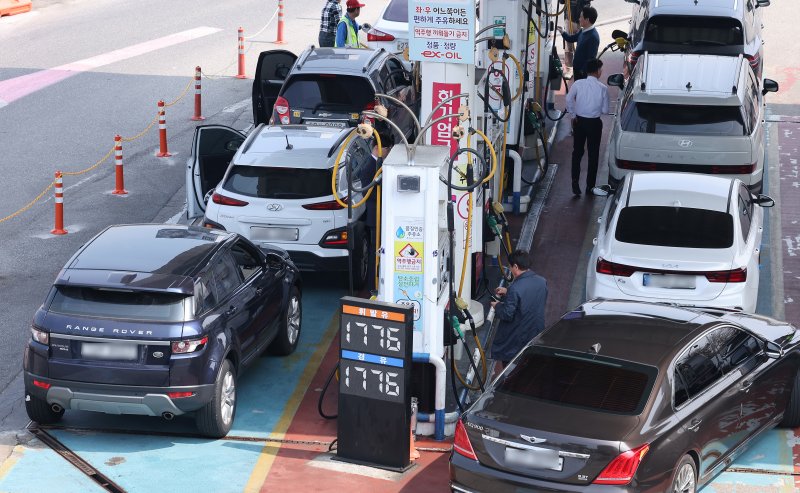
According to Financial News, the government will implement the second phase of the maximum oil price system from the 27th, raising both gasoline and diesel caps by more than 200 won. As a result, pump prices are expected to climb into the 2,000-won-per-liter range.
The Ministry of Trade, Industry and Resources (MOTIR) announced at a meeting of the Task Force of Related Ministers for Special Management of Consumer Prices the previous day that, starting at midnight on the 27th, the maximum prices applied to refinery supply prices to gas stations will be set at 1,934 won per liter for gasoline, 1,923 won for diesel, and 1,530 won for indoor kerosene. These caps will remain in place for the next two weeks. Marine diesel for vessels has also been newly added to the scope of the maximum price system.
The cap is being raised because Singapore petroleum product prices, which serve as the benchmark over a two-week period, have surged sharply.
Compared with the first maximum oil prices applied over the past two weeks (1,724 won for gasoline, 1,713 won for automotive diesel, and 1,320 won for kerosene), all fuel types are increasing by 210 won. The government stated that it reflected the rise in international crude prices, but minimized the size of the hike by more than doubling the fuel tax cuts (for gasoline from 7% to 15%, and for diesel from 10% to 25%) and by making additional policy adjustments.
The maximum price is the upper limit on the wholesale price that refiners can charge gas stations. Since gas stations add operating costs and margins on top of this cap, consumer prices at the pump are expected to exceed 2,000 won per liter.
At a briefing, Yang Ki-uk, Director-General for Industrial and Resource Security at MOTIR, said, "It is not easy to predict what the final pump prices will be, but based on our experience with the first phase of the maximum price system, we expect final consumer prices to settle in the low 2,000-won range."
Although the government has more than doubled the fuel tax cuts until May 31—lowering the gasoline fuel tax by 65 won from 763 won to 698 won per liter and the diesel tax by 87 won from 523 won to 436 won per liter—international oil prices have risen even more, making it difficult for consumers to feel the benefit of the tax reductions.
Marine diesel for vessels has been added to the list of fuels covered by the second maximum price. This measure takes into account the management burden on fishermen caused by high oil prices. For tax-exempt fuels such as marine diesel, the cap is applied to the price excluding taxes. In addition, the government will temporarily raise the subsidy rate for the diesel price-linked support program for freight trucks and buses from the current 50% to 70% through April.
Items with a high dependence on the Middle East will be subject to intensive monitoring. For Naphtha, where supply chain instability is emerging, the government will implement emergency supply measures that include mandatory reporting of production and import volumes, a ban on hoarding, and export restrictions. For urea and diesel exhaust fluid (urea water solution), a notice banning hoarding will be applied to help stabilize supply and demand.
At the Emergency Economic Review Meeting that day, President Lee Jae Myung of South Korea urged, "We ask for active cooperation from gas stations on the front lines," and stressed, "Acts of collusion or other practices that seek unjust profits by exploiting this crisis facing our community can never be tolerated."
moon@fnnews.com Moon Young-jin Reporter