[Editorial] Set aside partisan strife at least until the war ends
- Input
- 2026-03-26 18:43:05
- Updated
- 2026-03-26 18:43:05
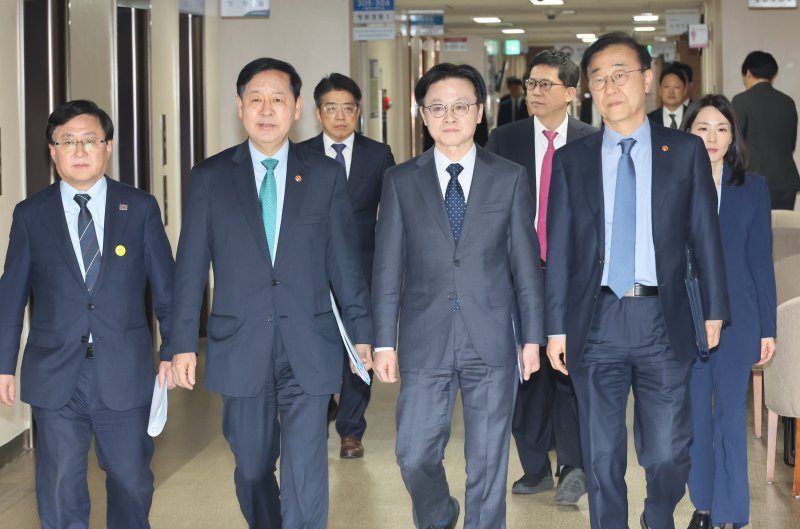
At the same time, the government and the ruling party, The Minjoo Party of Korea, held a consultation between the government and the ruling party to discuss project plans to be included in a 25 trillion won "war supplementary budget." The package is expected to cover compensation for losses stemming from the introduction of the Petroleum Product Price Ceiling System, the revival of the Residential Renewable Energy Supply Program for households, and support for companies located in an industrial crisis zone. It is also highly likely to include measures such as providing livelihood support payments via local currency, launching the K-New Deal Academy to draw discouraged young jobseekers back into the workplace, assistance for victims of rental scam schemes, and support for the increase in prices of inorganic fertilizer.
The reason the president and the ruling camp are moving quickly to respond to the Middle East crisis is that the situation is that grave. As the war drives up international oil prices and raw material costs, some domestic petrochemical plants have already been forced to halt operations. In the food and beauty industries, companies warn that if the conflict drags on, they may not only face higher costs but also fail to secure packaging materials at all, disrupting product shipments. With the supply of naphtha, a key raw material for plastic film, becoming unstable, some households are even rushing to stock up on volume-based trash bags, a sign of rising public anxiety.
Even as the Middle East crisis directly affects companies and households, political conflict between the ruling party and the opposition parties is only intensifying. Over the supplementary budget, the opposition parties have denounced it as "handouts for electioneering" and said, "They must stop wrecking the economy and people’s livelihoods." The ruling party has fired back, calling such remarks "heartless rhetoric that turns a blind eye to people in pain." At a time when Korea should be cushioning the external shock of war and high oil prices and preparing for the future, it is hard to find any spirit of cooperation in politics.
The real problem is that political strife is escalating even though the entire nation should be focused on responding to an economic crisis. The ruling party and the opposition parties are locked in fierce confrontation over the Special Committee for a National Investigation into Alleged Fabricated Indictments by Political Prosecutors under the Yoon Suk Yeol Administration. They are also clashing sharply over the push by the broader pro-government camp to file an impeachment motion against Chief Justice of the Supreme Court of Korea Cho Hee-dae. If, in the midst of war-induced economic shocks, politicians cling to partisan battles and power struggles instead of the national interest, the country’s capacity to respond to the crisis can only be weakened.
To overcome a compound crisis of war, high oil prices, and supply chain instability, the speed and consistency of policy are crucial. Yet as long as the ruling party and the opposition parties remain locked in extreme confrontation, no crisis-response measure is likely to produce real results. If the supplementary budget, the energy policy package, and industrial support measures are delayed or distorted in the National Assembly, market anxiety will grow and confidence in government policy will inevitably be shaken.
No one can predict when the current Middle East crisis will end, and its economic shock is likely to linger long after the war is over. In such circumstances, if politicians become consumed by power struggles or focus solely on smearing their rivals, the crisis will only deepen, and the burden will ultimately fall on citizens and businesses. To protect livelihoods and the economy, the ruling party and the opposition parties must build a shared understanding of the situation and move swiftly and consistently on support measures and long-term strategies. What politics must deliver now is not a blame game, but bipartisan cooperation in the face of a national crisis.