[Editorial] Welcome rise in births, but South Korea must stay the course on population reform
- Input
- 2026-03-26 18:43:02
- Updated
- 2026-03-26 18:43:02
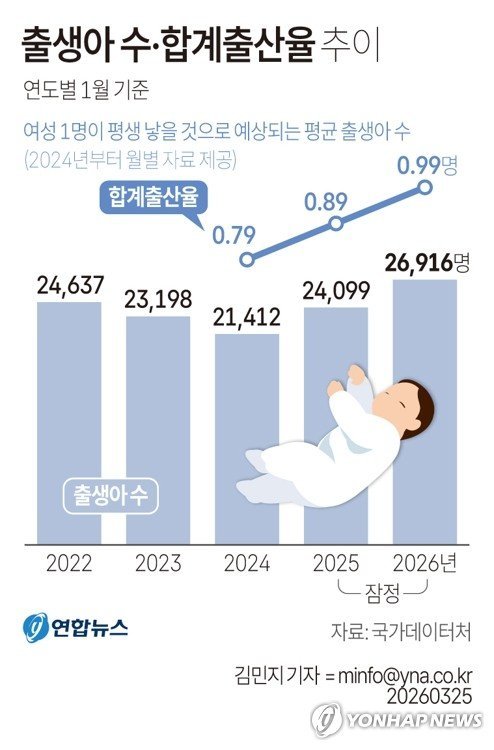
We need to examine what is driving the increase in births. One factor is a deferred effect: marriages that were postponed during the COVID-19 pandemic are now taking place in a concentrated wave. In addition, the so-called "echo boom generation"—those born between 1990 and 1996 to the second baby-boom cohort—is now entering its 30s, the prime childbearing years, creating a demographic cycle effect.
Given these background factors, it is hard to see the current rebound as the result of structural change. It may well be a temporary shift produced by several exceptional circumstances overlapping. There is still a wide gap with the replacement-level fertility rate of 2.1 children per woman, which is needed to keep the population from shrinking.
History also warns against easy optimism. In Europe, which confronted low fertility earlier, it took decades for some countries to trace a U-shaped recovery in birth rates. Even in nations such as France and Sweden, which managed a rebound, the process involved many years of building work-family balance systems, expanding support for childbirth and childcare, and changing social and cultural attitudes. Countries that relaxed their policy efforts after short-term improvements in the numbers slipped back into a downward spiral.
Where does this leave South Korea today? Structural barriers that discourage having children remain high: the burden of housing costs, a fiercely competitive education environment, a persistent gender pay gap, and insufficient social provision of care. The figures may have shifted, but the environment for having and raising children has hardly changed. A rising line on the birth statistics does not automatically mean that young people’s lives have become more conducive to starting families.
This is no time to relax just because of a recent uptick. What we must guard against most is complacency built on a fragile rebound. A one- or two-year increase in births is no justification for loosening the reins on low birth rate policy or letting our guard down. The Presidential Committee on Ageing Society and Population Policy has, of course, stated that it will consistently pursue work-family balance measures to support a higher total fertility rate.
But declarations alone are not enough. The actual use of parental leave must be raised, and the institutional framework must be strengthened so that having and raising children is not seen as an individual sacrifice but as a shared responsibility of society. The effectiveness of the low birth rate support programs currently in place also needs to be rigorously assessed.
South Korea still carries the stigma of having one of the fastest rates of low fertility and population ageing in the world. Even if births increase, the overall demographic structure will not improve if the elderly population continues to grow rapidly. Low birth rate and ageing are two sides of the same coin. Policies to address both must be pursued with even greater urgency so that the small spark of rebound does not go out.