Ruling party and government speed up 25 trillion won 'war-time extra budget'... livelihood support payments to be targeted
- Input
- 2026-03-26 18:24:42
- Updated
- 2026-03-26 18:24:42
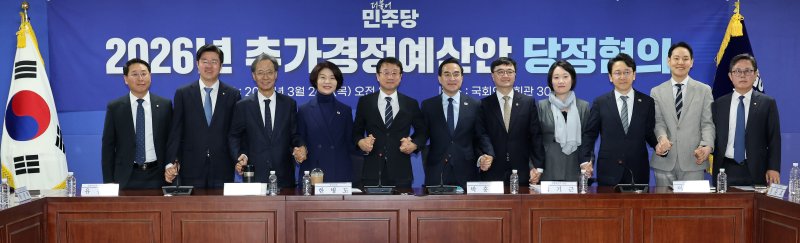
At the party-government meeting on the extra budget held that day at the National Assembly of the Republic of Korea, they agreed to allocate budget funds for the livelihood support payment.
The livelihood support payment will be provided in the form of local currency, and the beneficiaries will not be the entire population but relatively vulnerable groups and low-income households. The decision to make it targeted reflects the view that the price ceiling on petroleum products already functions as a de facto universal welfare measure for all citizens. However, the exact amount of the livelihood support payment and the detailed eligibility criteria have not yet been decided. They are expected to be disclosed after the extra budget bill is approved at the State Council of South Korea on the 31st.
The extra budget will also be used to support companies. The government plans to prevent a credit crunch and expand policy financing for exports, with the aim of helping firms respond to the crisis. Tailored assistance will be provided to companies located in industrial crisis zones that have been hit hard by the Middle East war. Businesses in areas such as Yeosu and Ulsan Metropolitan City, where petrochemical industrial complexes are concentrated, are expected to be among the beneficiaries.
The extra budget will include projects to expand strategic oil reserves and compensate for losses incurred under the price ceiling on petroleum products, in order to cope with high oil prices and stabilize supply chains. Funds will also be secured through the extra budget to procure key strategic items such as Naphtha and rare-earth elements.
As concerns over South Korea’s high dependence on oil have resurfaced due to the Middle East war, the ruling party and the government also decided to secure funding through this extra budget to expand residential renewable energy. Lee So-young, a DPK member of the Special Committee on Budget and Accounts, said, "There is already a limited Residential Solar Subsidy Program for households," and added, "This time, we intend to significantly increase new funding so that people living in major cities can adopt a 'one household, one solar panel' model and produce a certain portion of their own energy independently."
In addition, the ruling party and the government agreed to secure budget funds to raise the reimbursement rate of the currently operating "K-Pass" scheme, as part of an incentive program to encourage the use of public transportation and save energy.
The extra budget will also expand youth job creation programs, allocate funds to guarantee a "minimum deposit" for victims of rental scam cases, and increase support for settling unpaid wages to bring an early end to wage arrears cases such as the Homeplus fiasco. Pre-emptive expansion of support in the culture, arts, and tourism sectors is likewise expected to be included in the extra budget.
Regarding the timetable for reviewing the extra budget, Lee said, "Given the urgency of the situation surrounding the extra budget, we are trying to conduct the review at the National Assembly as quickly as possible."
The DPK has repeatedly stressed that it will handle the review of the extra budget at the fastest possible pace, with the goal of passing the bill at the plenary session of the National Assembly of the Republic of Korea on the 9th of next month.
Kim Hyeong-gu ([email protected])