Packaged Death Becomes Art [Weekend Culture]
- Input
- 2026-03-27 04:00:00
- Updated
- 2026-03-27 04:00:00
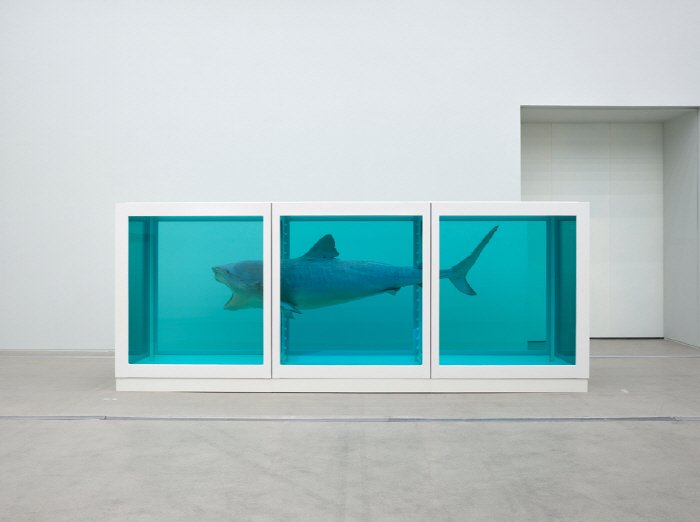
In Samcheong-dong, Jongno District, Seoul, a singular body of work unfolds that translates into visual language the obsessions of contemporary society: life and death, the desire for transcendence, science as a substitute for religion, and the logic of capital that sells immortality.
The National Museum of Modern and Contemporary Art, Korea announced on the 26th that it will present a major solo exhibition, "Damien Hirst: There Are No Facts, but There Is Always the Possibility," at the National Museum of Modern and Contemporary Art, Seoul through June 28. This is Asia’s first large-scale retrospective of Damien Hirst, surveying roughly 35 years of his practice from his late-1980s early works to recent paintings. The exhibition features key pieces that explore human desire and belief around death, faith, science, medicine, and capital. On view are "The Physical Impossibility of Death in the Mind of Someone Living," a shark suspended in formaldehyde; "A Thousand Years," which uses a cow’s severed head and fly larvae; the diamond skull "For the Love of God"; and the "Medicine Cabinets" series, among others. Among these, "A Thousand Years" and "The Physical Impossibility of Death in the Mind of Someone Living" are being shown in Asia for the first time.
The first section, "Every Question Requires Doubt," focuses on early works that brought Hirst attention as both curator and artist. It includes collages he created in his late teens and early twenties as he searched for a visual language that suited him. Also featured are photographic works from his teenage years shown at his first solo exhibition, along with early versions of his representative "Spot Paintings" series.
In the second section, "We Live in Time," visitors encounter large-scale installations using glass vitrines, including the so-called "shark." The much-discussed shark piece is being shown in Korea for the first time since it was exhibited at Tate Modern in 2012. The National Museum of Modern and Contemporary Art, Korea noted, "We transported the shark and the tank separately and installed them here, which was a major physical undertaking," adding, "You may not have another opportunity to see this work outside of this exhibition."
Also on view is "A Thousand Years" (1990), which uses a cow’s severed head, fly larvae, and an insect killer to render the cycle of life and death in raw, unfiltered form.
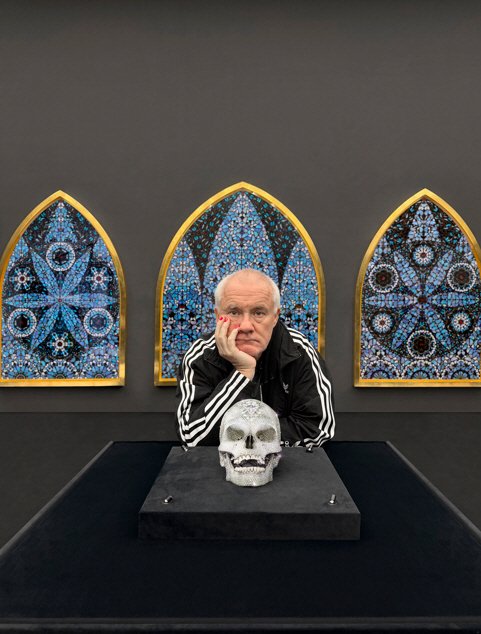
The third section, "The Luxury of Silence," centers on works that explore the complex relationships among science, religion, and art. Dominating the middle of the space is "For the Love of God," a work made by casting an actual human skull in platinum and setting it with 8,601 diamonds. The piece juxtaposes boundless human desire with the transience of life. When it was first unveiled at White Cube in London, its production cost alone set a record price for a work by a living artist, drawing widespread attention.
Also included is the triptych "Contemplating the Infinite Power and Glory of God," made with thousands of butterfly wings, and a partial reconstruction of "Pharmacy," the restaurant Hirst opened in London in 1998 and ran for six years, installed within the exhibition space. In an open gallery area, "Artist's Studio: Work in Progress" recreates Hirst’s London studio almost exactly as it is. Visitors can see the unfinished "River Painting" series, which he has been working on for three years, along with other incomplete, previously unseen paintings, brushes and paints, work clothes and shoes, and a worn sofa—an immersive creative environment that offers a vivid glimpse into the artist’s thoughts and actions.
Kim Sunghee, Director of the National Museum of Modern and Contemporary Art, Korea, stated, "We sought to shed multifaceted light on the innovative experiments and works of Damien Hirst, an international artist who has shaped the course of contemporary art," adding, "I hope this exhibition will provide an opportunity to deeply reflect on values and existence in contemporary society." Often described as the "enfant terrible" of contemporary art, Damien Hirst was born in Bristol in 1965 and grew up in Leeds. While studying at Goldsmiths, University of London, he curated the 1988 group exhibition "Freeze" featuring fellow students, which brought him global attention. In 1995, he received the Turner Prize, the United Kingdom’s most prestigious contemporary art award.
rsunjun@fnnews.com Yoo Sun-joon Reporter