Securities Firms’ Net Profit Nears 10 Trillion Won on Booming Stock Market, Up 39% from a Year Earlier
- Input
- 2026-03-26 09:06:01
- Updated
- 2026-03-26 09:06:01
[The Financial News] The securities industry posted record earnings last year on the back of a booming stock market. Higher stock trading value boosted brokerage commission income, while the corporate finance (IB) and Wealth Management (WM) divisions also delivered solid growth, pushing net profit close to 10 trillion won.
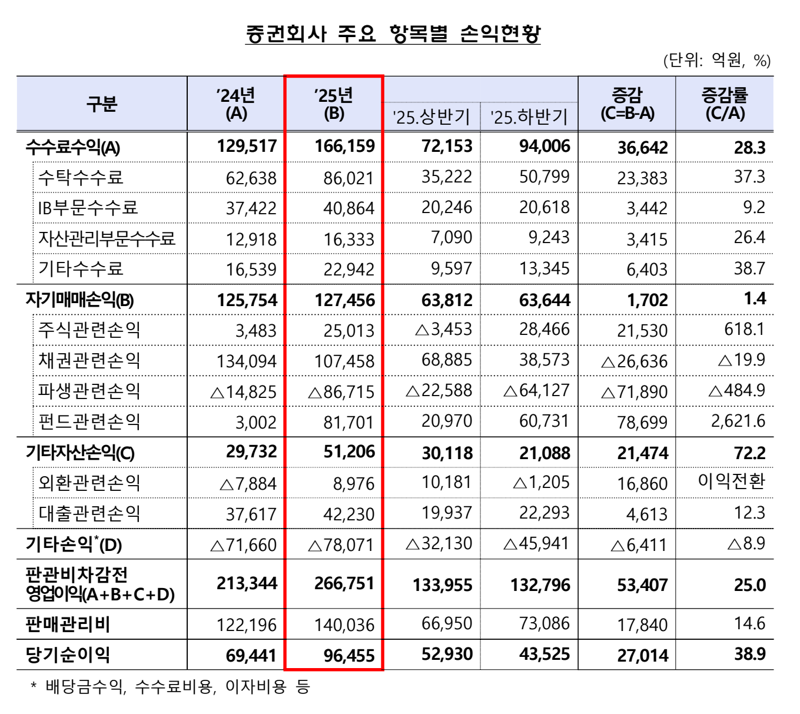
According to the "Provisional 2025 Business Results of Securities and Futures Companies" released by the Financial Supervisory Service (FSS) on the 26th, aggregate net profit at 61 domestic securities companies came to 9.6455 trillion won last year. This represents an increase of 2.7014 trillion won, or 38.9%, from 6.9441 trillion won a year earlier. Net profit has now risen for three consecutive years, with the pace of growth also accelerating.
Brokerage commissions were the primary driver of the earnings improvement. As domestic and overseas stock markets rallied and stock trading value surged, brokerage commission income jumped 2.3383 trillion won, or 37.3%, year-on-year to 8.6021 trillion won. From the first quarter of last year, trading value on the alternative trading system (ATS) was included, which significantly expanded market liquidity. Annual trading value on the Stock Market Division of the Korea Exchange and the KOSDAQ Market reached 6,348 trillion won, up 36% from the previous year.
Growth in the IB and Wealth Management divisions was also notable. IB fee income rose 9.2% year-on-year to 4.0864 trillion won, supported by higher fees from underwriting, arrangement and debt guarantees. The Wealth Management division generated 1.6333 trillion won in revenue, up 26.4% from a year earlier, as fees from fund sales and discretionary investment services increased.
An expansion of margin lending and other credit provision, led by large securities companies, also contributed to earnings. As credit provision by Comprehensive Financial Investment Business Entities increased, loan-related profit and loss improved by 461.3 billion won compared with the previous year. As a result, the average return on equity (ROE) of securities companies reached 10.0%, up 2.1 percentage points year-on-year, marking a double-digit return.
Buoyed by strong results, key financial soundness indicators at securities companies also improved. As of the end of last year, total equity capital at securities companies stood at 102.4 trillion won, an 11.7% increase from the end of the previous year.
Total assets rose 25% year-on-year to 943.9 trillion won, while total liabilities expanded to 841.5 trillion won, driven by an increase in customer deposits. The average Net Capital Ratio (NCR), a key soundness indicator, came in at 915.1%, far exceeding the regulatory minimum of 100%. Large firms, with an NCR of 1,316.0%, and Comprehensive Financial Investment Business Entities, at 1,894.3%, showed particularly strong capital buffers.
Net profit at the three futures companies was 88.6 billion won, up 10.8% from a year earlier, indicating modest growth.
The FSS assessed that the latest results reflect simultaneous earnings improvement at both large and small-to-mid-sized securities companies thanks to the buoyant stock market, but it also stressed that it will not relax its focus on risk management going forward.
An FSS official stated, "There are growing concerns about rising domestic and external uncertainties, including the recent situation in the Middle East, heightened stock price volatility and higher market interest rates," adding, "We plan to closely monitor the liquidity and soundness of securities companies and to encourage the preemptive disposal of non-performing assets." The official went on to say, "We will enhance the industry’s loss-absorbing capacity by improving the methodology for calculating the NCR and refining the liquidity regulatory framework."
[email protected] Kim Mi-hee Reporter