Soaring Exchange-Rate Volatility Fuels Inflation Pressure... Will ‘Hawk’ Hyun-Song Shin Raise Rates? [US–Iran War]
- Input
- 2026-03-25 18:21:59
- Updated
- 2026-03-25 18:21:59
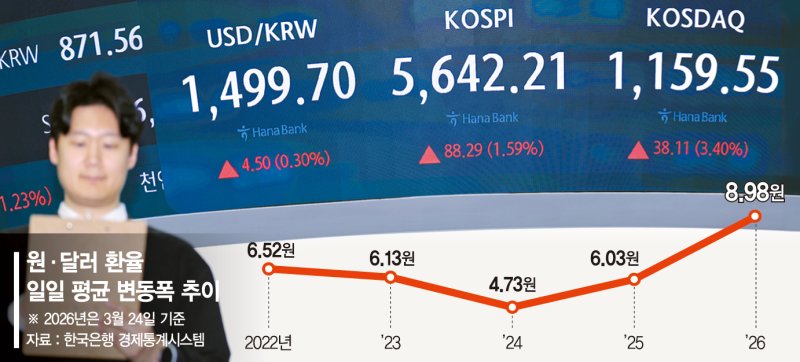
■ Daily swings of 9 won... mounting exchange-rate anxiety
An analysis of the Bank of Korea (BOK) Economic Statistics System (ECOS) on the 25th shows that, so far this year, the average daily trading range of the US Dollar–South Korean Won exchange rate, based on closing prices, has been 8.98 won. In other words, the rate has been moving nearly 9 won up or down on an average day. This is 2.85 to 4.25 won wider than the annual averages for 2023 (6.13 won), 2024 (4.73 won), and 2025 (6.03 won). Even this month, about 35% of trading days have seen intraday moves of more than 10 won, underscoring heightened instability in the market.
Experts stress that sharp swings in the exchange rate, rather than its absolute level, impose a heavier burden on the economy. Jeong Yong-taek, an economist at IBK Securities, said, "The role of the foreign exchange authorities is less about defending a specific line like 1,500 won and more about curbing sharp swings to control volatility," adding, "If the Middle East situation is resolved and the exchange rate suddenly plunges, that could create problems for exports as well."
Typically, when the exchange rate rises, importers are hurt because they must buy goods at a higher effective price, while a falling rate disadvantages exporters who are forced to sell more cheaply. If the rate keeps jumping up and down, both sides suffer repeated losses before they can hedge, and that damage spills over into the broader real economy.
■ Few tools left for the foreign exchange authorities
There are only limited tools available to rein in volatility. Kang In-soo, a professor of economics at Sookmyung Women's University, argued, "In effect, we have to say that exchange-rate volatility is not being managed," and pointed out, "Foreign reserves may look ample at 430 billion dollars, but Korea also needs to prepare for investments in the United States of America (US), so it is not in a position to pour large sums directly into the FX market." Kim Sang-bong, a professor of economics at Hansung University, also noted, "For now, verbal intervention is about the best that can be done."
The weakening of the traditional relationship between interest rates and the exchange rate is another concern. Economist Jeong Yong-taek explained, "Normally, when interest rates rise, the exchange rate should fall, but recently we have seen the opposite," adding, "This shows that even if Korea adjusts domestic interest rates, it will be difficult to defend the currency."
Against this backdrop, some argue that Korea should focus less on short-term intervention and more on strengthening market resilience. Seungho Lee, Senior Research Fellow at the Korea Capital Market Institute, said, "Korea needs to maintain a current-account surplus and enhance incentives for foreign investment in domestic securities," and added, "If trading volume in the FX market increases and more participants join, one-sided moves in the exchange rate can be alleviated."
■ Hyun-Song Shin’s leadership emerges as a key variable
Geopolitical risks stemming from the Middle East are also affecting monetary policy. Rising international oil prices and greater exchange-rate volatility are combining to push inflation upward, weakening the previously dominant market expectation for interest-rate cuts.
Professor Kang In-soo warned, "If the war drags on, higher oil prices could make inflation management even more difficult," and said, "In such circumstances, the more likely path is to keep rates on hold or even raise them, rather than cut." He continued, "If a scenario of military escalation materializes, oil prices could spike, and if that coincides with a weaker won, import prices will surge, making it much harder to control inflation." Kang added, "In that case, Korea may have to raise interest rates to rein in prices," but cautioned, "If rate hikes are carried out while the economy is already slowing, concerns about stagflation—where consumption and production contract at the same time—will grow."
Professor Kim Sang-bong likewise commented, "Given the burden of household debt, it is difficult to raise policy rates immediately, but market interest rates are already on an upward trend," and said, "Depending on how interest rates move in major economies such as the US and Japan, the possibility of a rate hike in Korea remains open."
The policy stance of Hyun-Song Shin, nominated as the next governor of the Bank of Korea (BOK), is another key variable. Market participants generally view him as a "pragmatic hawk" who places strong emphasis on fighting inflation. In the past, he has argued for preemptive action on prices, saying, "It is far better to overreact than to respond too timidly." Ultimately, the future path of monetary policy will be heavily influenced by external factors such as the exchange rate, oil prices, and global interest-rate trends. If upward pressure on inflation persists, many analysts expect the BOK to prioritize price stability over supporting growth. With rising exchange-rate volatility, geopolitical risks, and a possible shift in the monetary-policy stance all intersecting, uncertainty in financial markets is set to increase further.
[email protected] Hong Ye-ji, Kim Tae-il Reporter