Investors Flee Nauseating Market Swings for ‘Defensive ETFs’... "Defense Mode for Investors"
- Input
- 2026-03-25 18:15:19
- Updated
- 2026-03-25 18:15:19
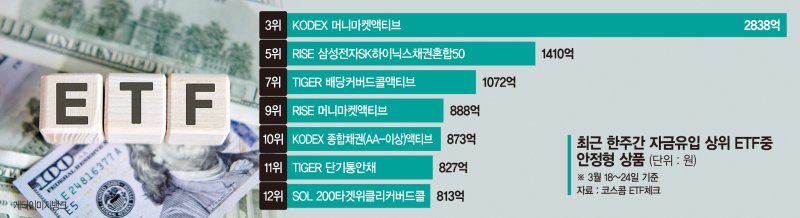
According to Koscom data service ETF Check on the 25th, stable ETFs accounted for half of the 10 ETFs with the largest net inflows over the past week (18–24). During the week, the parking-type product "KODEX Money Market Active" saw a net inflow of 283.8 billion won, the third-largest among all ETFs.
Parking-type ETFs take their name from the idea of "parking" cash for a short period and then pulling it out, making them suitable for short-term cash management. They offer greater liquidity and convenience than deposits, and interest accrues even if funds are parked for just one day. As a result, they tend to attract strong inflows when uncertainty is high.
The bond-balanced product "RISE Samsung Electronics-SK Hynix Bond Balanced 50" ranked fifth with a net inflow of 141 billion won. The covered call product "Mirae Asset TIGER Dividend Premium Active ETF" came in seventh with 107.2 billion won in net inflows. Bonds are generally less volatile and carry a lower risk of loss. On this basis, asset managers have been launching bond-balanced products that combine stocks and bonds in one portfolio to pursue both stability and returns.
Covered call ETFs buy underlying assets such as stocks while simultaneously selling call options—the right to buy the stock at a preset price—to earn option premiums. They tend to lag in rising markets, but when share prices fall, the premiums help cushion part of the losses.
ETFs in ninth to twelfth place were also bond or covered call products. They were "RISE Money Market Active ETF" (88.8 billion won), "KODEX Aggregate Bond (AA- or Above) Active ETF" (87.3 billion won), "TIGER Short-Term Monetary Stabilization Bonds ETF" (82.7 billion won), and "Shinhan SOL 200 Target Weekly Covered Call ETF" (81.3 billion won), in that order.
As the conflict involving the United States of America (U.S.), the State of Israel and the Islamic Republic of Iran drives extreme volatility, funds are moving into relatively stable ETFs. In fact, the KOSPI 200 Volatility Index (VKOSPI), often called Korea’s fear gauge, surged to 80.37 on the 4th, the highest level since the 2008 financial crisis. It has since fallen back into the 60s, but remains elevated compared with last year’s average of 24.08.
Lee Won, a researcher at Bookook Securities, said, "Cash sitting on the sidelines of the stock market is increasingly hiding in ultra-short-term safe assets when it leaves equities," adding, "If retaliatory attacks by the Islamic Republic of Iran intensify again, the exchange rate could spike, making active risk hedging essential."
Yun Won-tae of SK Securities noted, "In the credit market, risks related to private debt, real estate and marginal borrowers could lead to weaker sentiment and a liquidity squeeze," and added, "Questions over the sustainability of the Artificial Intelligence (AI) investment cycle and concerns about overvaluation are also increasing valuation pressure across risk assets." However, he pointed out, "Given that individual margin balances are rising in both Korea and the U.S., risk appetite among investors is still intact."
[email protected] Seo Min-ji Reporter